August 8th, 2008 was a momentous day. Not only was it our daughter’s first birthday (which qualifies us as semi-responsible parents), but the Summer Outdoor Retailer show started in Salt Lake City. As if that wasn’t enough… “Heart of Stone” was also released on YouTube.com. This was the practice film we produced at the Serac Adventure Films film school last week and features some stellar acting. As a bonus, this version is the Executive Director Mercy Cut which brings it down to ten minutes.
Keep your expectations low and check it out below…
________________________________
Help support StraightChuter.com and get 15% off on a parentally responsible Chariot Cougar 1 from Backcountry.com! Click the photo below…
Raw footage is to film as a tube of paint is to a painter – it helps to start with good quality, but the real artistry is how the paint or video is applied to the canvas/screen. In our case, we shot 2.5 hours of film and then spent 16 hours editing it. This seemed like a lot to me until Michael Brown mentioned it was typical to spend months editing a 45 minute film.
The editing process starts with labeling all of your tapes and transferring the individual clips into a computer. We were using Final Cut Pro, but the steps are the same for any software. First the footage is separated into scenes (interview, tree climb, etc) and within those scenes, the different camera are separated out onto different tracks. The end result is a timeline which looks like this: < < < < <. The advantage of this is that you can see all of your related footage at once and break it down into manageable chunks.
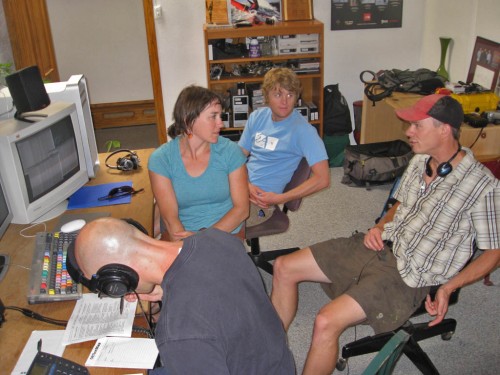
Geekin’ out at the Serac Adventure Films headquarters. The modern-day editing room looks a lot like an office with computers in it.
The Additive Process
Filming expeditions or adventures is tough as you never really know what you are going to get. Instead of spending days culling the footage down to eight hours, then four, then two, etc., Serac Adventure Films starts with whatever the best moment on film was and then adds whatever it takes to get to and from that moment. This works for both the overall focus of the film as well as individual sequences.
The next step is to start cutting different angles together which makes the film much more visually interesting. For instance, in real life if a person points to a mountain, your eyes would follow his gesture to the peak and the scene would change. It’s the same in film making, but it has to be done in a logical way or it seems disjointed. This is where detail and second camera shots come in handy as they provide a logical change of scenery (feet walking, stream crossings, etc.) if you want to denote a long event in a short period of time. A video fade-through-black does the same thing (denotes a passage of time), but as Ryan pointed out, this is cheating and it is far better to cut together scenes. For instance, a long shot of someone reaching for a rock followed by a few seconds of hands-on-rock details, then back to the long shot makes five minute ascent flow naturally in a matter of seconds.
At this point, we were starting to split hairs, or more appropriately, frames. The price of Final Cut Pro’s editing power is that it takes a while to learn, not to mention how long it takes to learn the art of editing itself. In our case, the SAF crew kept things moving along with flying fingers whenever our editing ambitions overcame our technical skills, which was most of the time.
SAF Editor Lam Nguyen’s blinding speed on Final Cut Pro made it look like he was playing Guitar Hero after a six-pack of Red Bull.
Once all of the separate scenes are done, they are assembled into an overall rough cut, which in turn is edited again for length and continuity between scenes. This is a reiterative process where little bits & pieces are trimmed, sound is balanced, over-dubbed voice tracks are added in and titles & credits are added. The finished result should hopefully look a lot like a movie…!
The Serac Adventure Films school is excellent and highly recommended. At times, expeditions can be tedious and boring, but after taking the class, hopefully my films will not be. As much as anything, the class gave me a greater appreciation for the art of film making and I swear I’ll never use a video cross-fade again (maybe).
A cross-fade free clip from the “Heart of Stone” International début…
________________________________
Help support StraightChuter.com and get 15% off on a V.I.O POV.1 Camera Pakage from Backcountry.com! Click the photo below…
Last year, Mountain Hardwear purchased a mini HD DVD camera, wide-angle lens, solar charger and all of the accessories needed to shoot videos on expeditions. I had a chance to take the kit with me on a trip into the Wrangell-St.Elias Mountains where I shot a bunch of crappy footage and edited together an even crappier little film which did not do justice to the trip. More than anything, the experience made me realize that a) making a film is hard and b) I knew nothing about the process.
Fortunately, the crew at Serac Adventure Films (SAF) in Boulder, Colorado know a LOT about making mountain movies, and not only that, they offer classes on how to do it. The classes are customized to whatever you want to do. Some people bring their own footage and edit it into a movie, or, as in our case, we spent a day shooting a mountain mockumentary, then two days editing it together just in time for a smashing/smashed début in the Jonny Cop Film Fest at the Amante bar. The buzz on Pearl Street is that “Heart of Stone” is going to go big. Really big. Like, it might even make it on to YouTube.com…
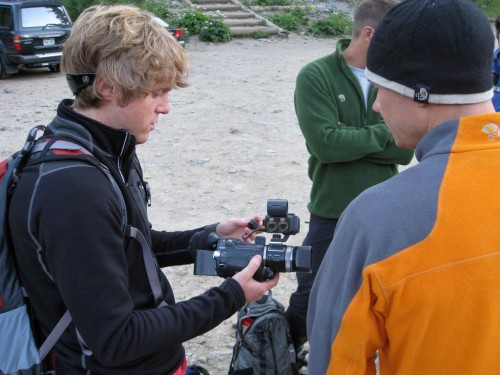
Ryan Ross of Serac Adventure Films explains which end of the camera is forward to Freddie Wilkinson.
The course itself was worthy of a documentary, mainly as there was so much to absorb over three days that it is impossible to remember it all. However, halfway through the class, my most burning question, “Is it just me, or does this process really take a long time?” was answered. Even though the final product may seem effortless and obvious, getting to that point takes a ton of time, effort, inspiration, editing, persistence and experience. Making a good film is fun, but a lot work.
Film the scene, not the shot.
Our first day out in the mountains started at 5:00am with three cameras, tripods, batteries and plenty of tapes. Ryan Ross of SAF had put together a rough outline of our mission for the day; work together to climb trees, cross streams, scale rocks, slide down slopes, resolve confrontations and develop love-affairs all in the name of finding “the perfect rock.” We took turns acting, directing and filming ten different sequences which amounted to a paltry two- and-a- half hours of tape by the end of the day, which was ultimately condensed down to a 15 minute film which could benefit from a mercy cut down to about seven minutes without missing too much.
Michael Brown showing the Rookies how to set up the main camera shot for the first confrontation scene.
Right away, we learned the importance of filming the scene, not just the shot. An exploding stove might be a good shot, but when it takes place in the remote mountains (the scene), it takes on a much greater importance. Along these lines, we also learned to shoot long, medium and detail shots which make scenes visually much more interesting. Michael Brown, the main owner of SAF and a friend from way back, equated long, medium and detail shots to the skiers checklist of skisbootspoleshatsglovesgoogles – you want to make sure to get them every time you go out.
Ryan Ross and David D’Angelo humor Chris Strasser as he sets up the main camera on the dramatic confrontation scene.
The plot unfolded throughout the day as we made it up. After starting with a classic interview, we then had to figure out how to integrate new characters into the scene in a logical (if barely) way and how they were going to interact. We came up with an overall plan of searching for the perfect rock with sub plots of two interns (Freddie & Janet) falling in love while at the same time there was increasing tension between the Professor (me) and the high-speed “rock enthusiast”, Kevin. Tempers flare and love blooms in the midst of a desperate high-altitude alpine search for the elusive “Heart of Stone.” (Don’t get your hopes up – it sounds more exciting than it really is.)
Tomorrow: Turning Rocks into Diamonds – The Editing Process…
________________________________
Help support StraightChuter.com and get 15% off on a battery charging Brunton Solar Roll from Backcountry.com! Click the photo below…