Tag Archive for 'gear'

Warm & Blister-free Boot Fitting

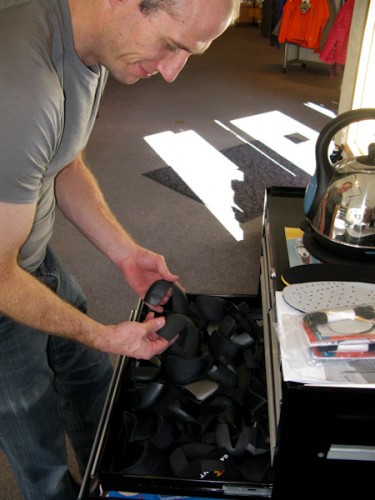
I’m happy to say that I haven’t had a ski boot related blister for years and the last one I did get came from trying to mold my own liners.  Some things are better left to the pros.

Here’s the not-so secrets to my blister free success…

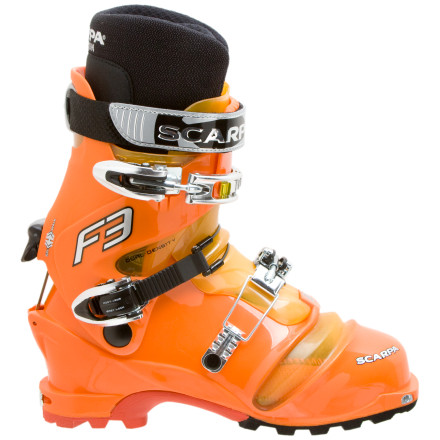
1) Go with boots that fit your feet.  I’ve been skiing in Scarpa’s for years and am not sure if they fit my feet or at this point my feet have conformed to the boots, but whatever the case, Scarpa’s are a known and consistent entity for me.   When I was into Alpine racing I wore a size 7 Lange, but for touring have gone up two full sizes to a size 9.

2) Use a thick, high quality sock like a Bridgedale, Smartwool or one of the new BC.com merino wool versions.  They are pricey ($25ish a pair), but they last forever, or seven years – which ever comes first.

3) Find an insole that fits your foot.  Some of the new boots come with substantial insoles (like the BD line), but I’ve found that SuperFeet fit my foot and are comfy.  I have been rolling them over for about five years and take them out of my old boots, then use them again for my new ones.

4) Use a good boot fitter who knows how to fit backcountry/touring boots, as a BC fit is different than an Alpine fit.  I’ve been going to Dennis Maw at Black Diamond in Salt Lake City who is a Liner Magician. Continue reading ‘Warm & Blister-free Boot Fitting’

Ski Bag Packing

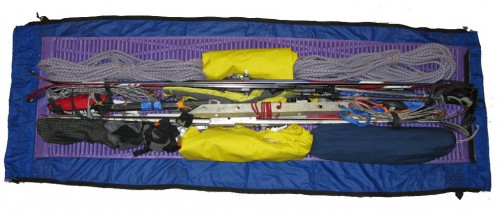
Whether you like it or not, skis count as a piece of luggage when flying, so I always try to maximize my ski bags utility by both stuffing it full of 49.995 pounds worth of gear, and also using my gear to pad my skis. Continue reading ‘Ski Bag Packing’
Favorite Glacier Rope

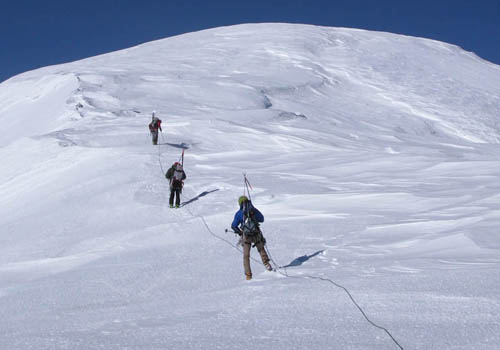
I’m slowly assembling my Antarctica kit and pulled out my favorite glacier rope tonight.  The sad thing is, I don’t even know the brand, but it doesn’t really matter – what is important is my fast and easy, do-it-yourself modification.  Starting with a 60m dry 9.1mm’ish rope, find the center, apply a sharp blade to it, and turn it into two ropes.  (That is, two 30m ropes, not two 60m 4.5mm ropes.)

There are a ton of advantages to having two similar/identical 30m ropes for glacier travel, but the main thing is flexibility.  You can travel with four people on a 30m, or break into two groups of two each with their own 30, or clip two ends to the middle person and go three or five on a 60, or leave one section in camp if you don’t think you’ll need it, or coil one 30m section up and bury it in a pack if you are traveling tight and fast… and many other options.  You can also do the same length rappel with as you would anyway (30m) by tying the two sections together.  The one big disadvantage is that you lose the ability to lead 60m pitches with gear placements (the knot won’t pass through biners), but that usually isn’t a big concern with ski mountaineering.  One the positive side, since 9.1′s are a bit sketchy for taking big whippers on (at least mine is), you can double up on the ropes and still lead 30m pitches. Continue reading ‘Favorite Glacier Rope’

New Addition to Glacier Kit

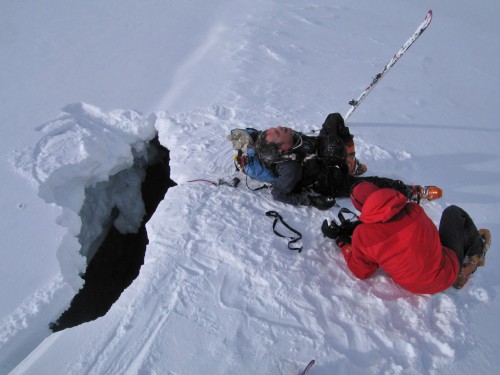
Much to the dismay of my partners, I am a minimalist when it comes to the amount of gear I bring for performing a crevasse rescue.  I bring a snow pickett for an anchor, waist and foot prussick loops, a 20′ cordelette, about six Oz carabiners, a screwgate locking carabiner and 2-3 full-length Dynex runners.  It may be less than ideal, but I hate having a ton of extraneous clanking gear clipped to my harness, plus, the best way to avoid taking a screamer crevasse fall is to make sure your rope is taut in the first place. Continue reading ‘New Addition to Glacier Kit’

OR Show – Cool Stuff

A last update from the OR Show…

I’ve been collecting knives for a while because I like how they often embody the cultures who created them.  Swiss Army knives are tight, compact and high quality, just like Switzerland.  American Buck knives are big, simple and durable – a bit like America. Italian switchblades are flashy and sexy… when they work.  The classic No. 10 Opinel knife from France is beautifully functional and dangerous.  I’m stereotyping and digressing, but within my knife collection I have a bunch of multi-tools as well.  I’ve always been loyal to the Leatherman brand, in part because I once saw Mr. Leatherman speak, and he was explaining how he started the company out of his frustration of having to carry a whole tool kit with him when traveling in Europe so he could fix the plumbing in hotel rooms.  It would never, ever, occur to me to try to fix the plumbing in a hotel room, but I admire his obsessive nature and the fact that he created an entire industry out of it.

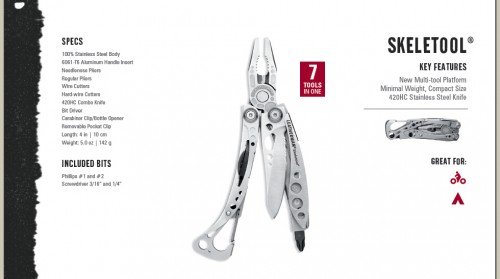
I own the original Leatherman, a Micro (nice, but a hassle with TSA types) and a Juice.  I recently ordered a Skeletool based on pure sex appeal alone as they are little works of art.  But, as soon as I got it, the bottle opener and wire-gate clip gave me some buyer’s remorse as they kind of cluttered up an otherwise elegant design.  I was ready to just suck it up, but Leatherman came out with the brand new Freestyle model, which is a streamlined Skeletool sans bottle opener, and perhaps unfortunately, the screwdriver.  These are very nice little units as the knife blade can be opened with one hand and the needle-nose pliers are surgically precise.  In general, both the Skeletool and Freestyle are much smaller than they appear in photos.  For reference, I can almost hide an entire Skeletool in my closed hand.  Still, I like’m a lot.

skeletool

The Skeletool with the bottle opener.

freestyle

The Freestyle tool - basically a Skeletool, sans bottle opener.

Continue reading ‘OR Show – Cool Stuff’

Interuption of Service

I’m never quite sure what to say when people ask me “What do you do for a living?”  If I say I’m a Professional Ski Mountaineer, that leads to all sorts of embarrassing questions, like, “Can you make a living at that?” (no) or “How many of you are there out there like that?” (two)  Usually I say I’m a writer, or photographer or freelance somethingorother. But, as a profession, I’m an Industrial Designer.  I did this for years, but then thought I better ski while I could and design later, and so far later has just kept getting later and later.

The Hotwire Carabiner - one of my favorite design projects while I was at Black Diamond Equipment.

My favorite design projects are for the outdoor industry, which conversely are also the lowest paying.  The higher paying projects are usually incredibly boring, but pay the bills so there is more skiing time.  Right now, I have an incredibly super boring project to work on, which will mean more skiing and skiing discussion later.

Happy turns,
Andrew

________________________________
Help support StraightChuter.com and get 12 months of my life compressed into two metal parts in the form of the Black Diamond Hotwire Carabiner from Backcountry.com. Click on the photo below…

Gear – A Question of Balance, Part II

In regards to balanced gear diets, here are my current favorites:

Superlight  (15% of the time)

   Skis – 160cm K2 Sahale (68mm waist)
   Bindings – Dynafit TLT’s without brakes
   Boots – Scarpa F1

Comments:  In the right conditions, I love this set-up as it tours effortlessly.  Because it is so light, you don’t have to be going very fast to feel like you’re haulin’ ass, so the thrill is the same as mach-schnelling downhill with a much heavier set-up.  The disadvantage is that it gets knocked around in anything less than ideal (corn/powder) conditions.

Medium Light (45% of the time)

   Skis – 167cm K2 Backouts (Euro skis similar to Chugoris/Summits – 72mm waist)
   Bindings – Dynafit ST Verticals with brakes
   Boots – Scarpa F3

Comments: I prefer this set-up whenever possible as I can ski powder, chutes, meadow skipping, etc. and it has it covered.  It tours very well but is a challenge when the snow gets tricky.  For expeditions, I take this set-up with the Scarpa Spirit 3 boots as the F3′s can get overpowered with a heavy pack or wind-jacked snow.

Medium Heavy (35% of the time)

   Skis – 167cm K2 Mt Baker Superlights (88mm waist)
   Bindings – Dynafit Comforts (no brakes)
   Boots – Scarpa Spirit 3

Comments: I use this set-up for powder, shorter tours or when I’m going out with a semi heavy-metal crowd.   I love the way it skis (especially powder), but there’s a weight penalty for longer tours. 

Heavy Metal Thunder (5% of the time)

   Skis – 167cm K2 Kung Fujas (twin tip alpine skis – 94mm waist)
   Bindings – Marker Dukes
   Boots – Scarpa Typhoons

Comments:  I use this set-up for kiting as I get yanked around and land backwards (twin-tips help), as well as resort skiing.  I like the Marker Dukes for this as they have excellent return-to-center abilities, a clean, predictable release and are brainless to step into.  Weight isn’t an issue as I’m probably not carrying them more than 100′.  Tourability is almost more of an insurance policy – it would be better than post holing.

An embarrasment of riches?  Yes, but it is a job and somebody has to do it.  :)

________________________________
Help support StraightChuter.com and cover some ground with a pair of Scarpa F3 Alpine Touring Boots on sale now at Backcountry.com. Click on the photo below…
 

Gear – A Question of Balance

Individually, skis, boots and bindings are important, but a far more significant concept is how they all work together.  I was reminded of this the other day when a friend mentioned that he didn’t think his new boots were stiff enough, which may have been the case, but then again, the 125mm waisted skis he was on may have just been too much for them as well.

Light is right... for long and/or fast outings.

Even if you buy all top-of-the-line gear, it can still seem “off” if it isn’t matched carefully.  A quiver of skis is nice, but a quiver of skis/boots/bindings is even better.  For backcountry skiing, I alternate between three set-up; superlight racing, lightweight all-purpose and the heavy-metal monsters.  I’d be hard pressed to pick a favorite as they all serve such differnt purposes, and in their respective catagories, I think they all ski really well.  On rare occassions I’ll use a heavier boot on a lighter ski, which can be fun as you can drive the ski like a nail and make it come around REALLY fast.

Mid weight, all around. Hard to go wrong, except if you are going really far, or really fast.

When I look at a new skis, boots or bindings, the catagory they are in (light, medium, heavy) is more important than the individual product.  For example, Dynafit TLT bindings (light), Scarpa Spirit 3 boots (medium), and K2 Coomba skis (heavy) are all great products, but would be a horrendous combination.  Conversely, when properly matched, the sum of an assembly of mediocre gear can be magical.

Heavy metal thunder (although not really a touring set-up).

 That said, if it skis good, it is good.  Your mileage may vary.

________________________________
Help support StraightChuter.com and go big with a pair of Scarpa Typhoon Alpine Touring Boots on sale now at Backcountry.com. Click on the photo below…

High Stakes Snow Anchors

When it comes to dedicated snow anchors, nothing beats the simplicity, strength and versatility of the classic Snow Stake, also known as a Picket, Snow Fluke or Snow Pig.  They are the ultimate do-it-yourself piece of climbing equipment involving not much more than a length of angle aluminum, a drill, hacksaw and some beer. 

Placed correctly, pickets (as I call them) can be unbelievably strong and provide a secure anchor in the middle of a blank field of snow for belaying, hauling, rappelling or lowering.  The metal ones are usually retrieved, although skiers have been known to make bio-degradable versions out of stout wood if they anticipate leaving them for a rappel.

Broken pickets from Don Bogies excellent study.
Broken pickets from Don Bogie’s excellent study.

A few years ago I was attending an AMGA Ski Guides Course when the instructor made an off-hand comment about how his picket was so strong it could hold ten people.  We all immediately challenged the claim, and after whacking it in and clipping a rope on to it, we lined ten people up and pulled as hard as we could.  The rope almost broke, but the picket held strong.  Pickets can be so reliable that it is easy to take them for granted, which can lead to accidents.  In 2003, four climbers died on Mt. Tasman in New Zealand as a result of a failed picket, which lead Don Bogie to conduct an exhaustive study on how to build, place, clip and best use them in all sorts of snow.

Click here for the pdf link to Don Bogie’s paper on Snow Anchors.

________________________________
Help support StraightChuter.com and keep your liver intact & anchors stout with an MSR Coyote Snow Picket from Backcountry.com! Click on the photo below…

Ode to the Voile Strap

Duct tape doesn’t work very well for the cold, wet environs of ski mountaineering, but it hardly matters as there is something way better – Voile straps.  In terms of classic designs, these are right up near the top and incredibly useful for almost anything, including holding your skis together.  I prefer the Old Skool versions with the metal buckles as they are lightweight, simple and never break. 
Voile Straps - the world would fall apart without them...
Voile straps – the world would fall apart without them.
I’m not sure where this design came from, but I first saw it used for skiing purposes by Mark W. at Voile, thus they are commonly called “Voile Straps.”  They can be used to clamp boots if a buckle breaks, hold a blown skin onto a ski, help split a broken leg, field-repair a binding, strap crap onto a pack, hold together a cook kit and just about anything else you can think of.
They work well by themselves, or you can chain them together for added reach.
Great on their own, or you can chain them together for added length.

The longer the better, although beggars can’t be choosers and any length will do.  I assume you can buy these things, but more often than not, they are handed out for free at skiing events where I always try to grab more than my fair share.

Strapping up in Iran - Greg VonDoersten photo.
Strapping up in Iran – Greg VonDoersten photo.

________________________________
Help support StraightChuter.com and pick up a few Classic Voile Straps from Backcountry.com! Click on the photo below…