Tag Archive for 'avalanche'

Page 2 of 3

Ditch the Plastic Shovel

By the numbers, plastic shovels are supposedly as strong (or stronger) than steel and able to withstand incredibly low temperatures.  Their big selling points are that they are lighter and cheaper than metal.  The weight claims are a bit suspect as plastic shovels tend to be on the small side, which naturally makes them lighter, but also less functional.  When it comes to cost, there is no denying they are less expensive, but is $30 really worth it?

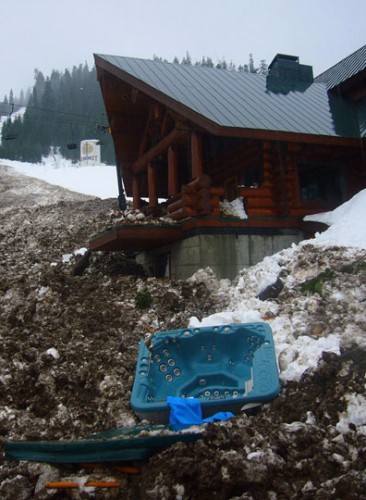
A plastic shovel which shattered catastrophically while digging a tent out.  The tent survived, but a buried partner probably would not have.
A plastic shovel which shattered catastrophically while digging a tent out. The tent survived, but a buried partner may not have.

The biggest issue with plastic shovels is that they fail catastrophically without warning.  A metal blade on the other hand usually gives you some warning (if you are paying attention) in the form of bending or cracking, and can be nursed through an expedition and/or replaced before they have a chance to fail in the field.

________________________________
Help support StraightChuter.com and get a reliable metal Dakine Wedge D-Handle Shovel from Backcountry.com! Click on the photo below…

Inside Info – Part II

The snowpack is the third major factor and also the trickiest one.  Like the weather, its history is more important than its immediate surface conditions. The plot thickens with the snowpack as there are almost always weaknesses in it, but they are difficult to quantify.  Snow is the building block of avalanches, but it is these tiny weaknesses between the blocks that actually cause them. Assessing the snowpack is difficult because these paper-thin layers are hard to identify and quantify amidst many feet of snow.

An avalanche triggered by a very surprised mountain lion in the Wasatch Mountains.  No cats were hurt during the making of this photo and the tracks led away from the debris.
An avalanche triggered by a very surprised mountain lion in the Wasatch Mountains. No cats were hurt during the making of this photo and the tracks led away from the debris.

Thinking of avalanches in terms of terrain, weather and snowpack simplifies the decision process as you need all or a combination of these elements to have a slide.  If the weather and snowpack are unstable, but you are on flat terrain, you won’t have an avalanche.  Or, if you are in avalanche terrain, but the weather and snowpack are stable, you probably won’t have an avalanche. 

Thinking in terms of this triad also makes it easier to extrapolate decisions when you are unsure of one of the factors.  If you are in a) avalanche terrain and know it has been b) storming for the last two days, it’s a safe bet that you will trigger some slides, even if you know nothing about c) the stability of the snowpack.

______________________
For 15% off on a Black Diamond Ascension Skins from Backcountry.com, click the photo below…

Inside Info – Part I

(continued from Monday’s ABC’s of avalanche train of thought)

With so many variables hidden under a blanket of white, where do you even begin?  Simplify the process by breaking it down into the big three categories; terrain, snowpack and weather.

Will it stay, or will it go now?  New snow, steep slope and a clear day... what to do?
Will it stay, or will it go now? New snow, steep slope and nice weather…

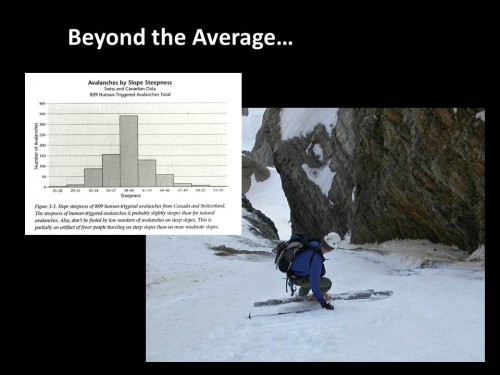
Terrain is the easiest.  If golf courses are too flat to avalanche and vertical walls won’t hold snow, the prime avalanche angle must be somewhere right in between.  As it happens, 38 degrees is the magic/tragic angle where avalanches are most likely to occur.  For reference, this is about as steep as an expert slope at a ski resort, or in other words, perfect ski mountaineering terrain.

Weather is the next factor and has a direct correlation with avalanches.  Stable weather means stable snow, and turbulent weather means turbulent snow.  The important weather information is its history, not necessarily what it is doing at the moment.  Statistically, most avalanche accidents happen just after a storm when the weather has cleared, but the snowpack is still adjusting to its new loading.  New snow is the big, obvious ogre, but wind is the evil villain that lays hidden deadly traps.  Rapid warming creates unusual avalanches and rain would be far more dangerous if it wasn’t so unpleasant to ski in.

continued tomorrow…
______________________
For 15% off on a Mountain Hardware Huckster backcountry skiing pack from Backcountry.com, click the photo below…

Snap, Crackle & Pop – The ABC’s of Avalanches

The physics of an avalanche is as easy to understand as placing one book on top of another, then tipping the lower book up until the top one slides off.  Voila – a bookalanche!  The grip or amount of friction between the books will determine how easily they slide apart.  If they are both dry and glossy, they’ll slide apart at almost any angle, but, if they have somehow bonded together through heat, humidity or moisture, you can turn them upside down and they may not come apart. 


One of my all time favorite avalanche education tools was this demonstration by the Alaska Avalanche School where layers of flour and sand are piled up on a flat board, which is then tipped up to 38 degrees where it rips loose and crushes the toys below.
One of my all time favorite avalanche education tools was this demonstration at the Alaska Avalanche School where layers of flour and sand are piled up on a flat board, which is then tipped up to 38 degrees where it rips loose and crushes the toys below.

This book example illustrates two important concepts of avalanches.  One, avalanches occur when a bond (friction) fails, and two; it can be difficult, if not impossible to predict exactly when that bond will fail without some additional information.  At times you could turn a mountain range over and shake it without the snow moving and at other times it will avalanche if you gently poke it with a ski pole.

______________________
For 15% off on a super-deluxe Pieps DSP transciever from Backcountry.com, click the photo below…

Photo Gallery – Shishapangma 1999

After discussing avalanche avoidance for the last few days, it seemed like a good time put up some photos from one of my worst avalanche experiences – Shishapangma 1999, where Alex Lowe and David Bridges died in a massive slide while scouting a route near the base of the line we were hoping to ski.

The event was covered by MountainZone.com and is still available on their website at:

http://classic.mountainzone.com/climbing/99/shishapangma/

Avalanche Avoidance – Salvation Through Education

It would be ideal of avalanche education was like driver’s education, where you studied and learned about the activity before physically doing it.  But alas it is not, and some skiers go their entire lives without taking a class.  Bad idea!  A lack of avalanche education should not be considered a backcountry badge of honor.  To make matters worse, the longer a skier goes without taking a class, the less likely they are to do so.  Someone who has been skiing for fifteen years is not going to be seen dead in an Avalanche Level 1 course.
Pitting out. Like a college degree, the actual information you learn in an avalanche class is secondary to learning the terms and methodology.

Avalanche education has a constantly changing curriculum that is worth keeping up on.  It is important to get in the habit of continuing education with avalanches, and the pros do it all the time through seminars, meetings and trade journals. 

More than anything, classes force you to think about avalanches, practice safe skiing, familiarize yourself with your beacon and look critically at snow.  Plus, they are often good places to meet partners with similar levels of enthusiasm and skills.

Avalanche education also helps to develop your vocabulary, which in turn is useful for deciphering avalanche forecast reports.  Learning that a “westerly front produced significant cross-loading on mid elevation ridgelines” doesn’t help you much if you have no idea what they are talking about!

______________________
For 15% off on a Black FlickLock Snow Saw from Backcountry.com, click the photo below…


Avalanche Avoidance – Part III

Snow is stable roughly 95% of the time, but the remaining 5% is often the most desirable time to go skiing, like right after a big phat powder dump on a bluebird day.  Avalanche safety takes years of practice and as much as anything else, it is about developing avalanche eyes for what will slide, how far it will go and what are your options.  Ernie Buehler, a guide at the prestigious Canadian Mountain Holidays heliskiing operation has guided thousands of clients through millions of feet of notoriously tricky terrain for over 30 years and only been caught in one slide. How? Patience, responsible terrain selection and more patience still.  You have to want to avoid avalanches. 

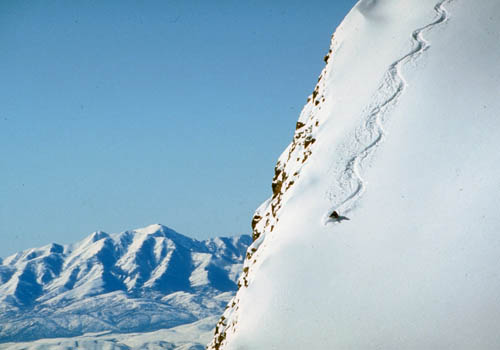
Taking the morale high ground on avalanches by staying above their starting zone.  Thunder Mountain, Alaska Range, AK. 2003
Taking the morale high ground on avalanches by staying above their starting zone. Thunder Mountain, Alaska Range, AK. 2003

Between new safety technology and changes in attitudes, people are venturing into more committing avalanche terrain than ever before.  In times past, avalanche education was as simple as telling skiers to stay out of avalanche terrain, which is still taught in parts of the world.  It’s not a bad idea, but also not reality.  What was once considered insane terrain is now skied before breakfast without a second thought.  Skiers are becoming much more educated about avalanche danger, but at the same time they are cutting the safety margins down to the bare minimums.

______________________
For 15% off on a Patagonia Light Smoke Flash Jacket from Backcountry.com, click the photo below…


Avalanche Avoidance – Part II

Avalanche safety is a blend of art and science.  The artful part has to do with route finding and safe travel protocol, while the science aspect is concerned with testing the snowpack and tracking the weather.  Both elements are important and ski mountaineers mix and match them according to their own personal interests.

Professional Avalanche Forecaster, Bruce Tremper, applying some science to the snowpack.

The science aspect of avalanche safety is akin to a college degree; something that is good to have, vital to understand, an excellent background and looks good on your resume, but the information is usually forgotten as soon as you graduate unless you go into avalanche academia.  Sticking to a ridgeline for an ascent is a far more practical way to avoid avalanches than calculating (T10-Tgnd) / (HS/10) =cTG.  As Bruce Tremper says in his excellent book “Staying Alive in Avalanche Terrain” there are many avalanche pros who would be “hard-pressed to tell a facet from a faucet, but they have nevertheless managed to develop a nearly infallible feel for the snow.”

…continued on Monday
______________________
For 15% off on The Avalanche Handbook from Backcountry.com, click the photo below…


Avalanche Avoidance – Part I

You know what an avalanche is, huh?  It’s what’ll kill ya.

Gabe – Alta Ski Patrol

The avalanche path and the skier can never truly be friends.  In the backcountry, the skier wants what the avalanche path has (steep & deep) but the avalanche  could care less about the skier and always has the upper hand.  It’s an uneasy relationship at best and it is important not to get too cozy with slide paths as they have a temperament of their own and should never be trusted.

An early morning avalanche.  At the time, avoiding getting swept down in the debris seemed like it was based on skill.  18 years later, I think it had as much to do with luck as anything!  Photo by Doug Hall.
An early morning avalanche. At the time, avoiding getting swept down in the debris seemed like it was based on skill. 18 years later, I think it had as much to do with luck as anything! Photo by Doug Hall.

As a base concept, avalanches are best avoided to begin with as it’s rare to win a fight with even a small one.   If you find yourself thinking that a slope will probably slide, but that it won’t go very big, or you’ll be able to outrun it, that is a classic Red Light.  Once you are caught, all bets are off and anything can happen, including terrain traps, shallow burials and stepping down.  Avalanches are difficult to accurately forecast in advance, yet painfully obvious in retrospect.  For this reason, I prefer to focus on avalanche avoidance instead of prediction.  Assume slopes are guilty until proven innocent and always watch your backside.

continued tomorrow…

______________________
For 15% off on Brunton Clinomaster (perfect measuring slope angles) from Backcountry.com, click the photo below…
 

America’s Deadliest Avalanche

I’d always assumed that the worst avalanche accident in America involved a remote mining town or had something to do with the Gold Rush stampede.  Miners were notorious for building towns like Alta right in the middle of avalanche run-out zones, then chopping down all of the surrounding trees/anchors for firewood.  If it wasn’t that, the classic old photos of hundreds of miners struggling up a mountainside all packed-in close together just screamed of a massive avalanche fatality waiting to happen.  So, I was thrilled to find out the truth in Gary Krist’s 2007 book “The White Cascade: The Great Northern Railway Disaster and America’s Deadliest Avalanche.” Much to my surprise, America’s deadliest avalanche took place in 1910 and involved a train stranded just below what is now the Steven’s Pass Ski Area in the Cascade Mountains of Washington State.  I had driven by this area dozens of times and after reading The White Cascade, we took a summer road trip up there to see if there was anything left of the disaster.

Although it is not clearly marked from Highway 2, the Forest Service and Volunteers for Outdoor Washington have done an excellent job preserving the disaster site and creating a handicapped friendly interpretive trail.  The exit is an unmarked paved road directly across the highway from Steven’s Pass which eventually turns into a dirt road and ends at the old Wellington town site.  The road is accessible by any 2wd car.  Once you know where to look, the accident site is clearly visible from pull-outs along Highway 2 heading downhill.

Map to the Wellington disaster site.

White Cascade gives a detailed account of the events leading up to the disaster, but it can be difficult to actually envision what the avalanche site was like as there are tunnels, sidings, depot’s and other nearby towns (Scenic) which all played a part in the accident and the ensuing rescue efforts.

 Annotated overview of the disaster site.
An annotated panorama of the Wellington disaster site taken from Highway 2.

As a brief overview, a train was crossing Steven’s Pass from Spokane to Seattle when it became stranded in a massive snowstorm at the town of Wellington.  To complicate matters, a “fast mail” train was also stranded in the same small area, as well as one or two rotary railroad plows which kept breaking down.  The passengers were trapped for about five days, during which time the storm intensified to a rate of up to 12″ of new snow per hour.  Storm totals were in the thirteen foot range before the temperatures warmed up and, in classic Northwest style, it began to rain.  There were avalanches ripping out all around them, but the passenger train itself was parked in an area which had never slid before.

Nowadays the slope is heavily forested, but prior to 1910, a forest fire had raged through the area and burned away most of the trees which helped anchor the snow.  Early in the morning of March 1st, the slope released in a massive avalanche which was roughly 3,000′ wide with the stuck train right in the middle of it.  The avalanche smashed the passenger cars “like an elephant stepping on a cigar box,” knocking it off the rails and down into the narrow ravine of the Tye River below.  As a further kiss-of-death, the heavy locomotives folded-in on top of the passenger cars, crushing anyone who might have survived the impact of the avalanche.  While a few people survived, 96 people died and it took months of work to dig out the last few bodies.

 Snowshed built in 1911 (one year after the accident).
The 98 year old remains of the snowsheds built after the accident.

After the accident, Wellington was renamed Tye in an attempt to calm passengers who were anxious about passing through the Wellington disaster site.  Snowsheds were added in 1911, although the ultimate fix would take eighteen years to complete and finally arrive in the form of the eight-mile long Cascade tunnel.

 The Wellington town site.
The tracks and the town of Wellington are long gone, but visitors can still find remnants of the concrete snowsheds and building foundations.

Both the trip to the site and the book “White Cascade” are excellent and highly recommended for avalanche geeks and non geeks alike.

______________________
For 15% off on a rainshedding Mountain Hardwear Crucial Jacket from Backcountry.com, click the jacket below…