Trivia:
Inclinometers are used in aircraft to show magnetic dip or the angle from the horizon.
Clinometers are used by surveyors in order to measure an angle of inclination or elevation.
Goniometers are instruments that either measures angle or allows an object to be rotated to a precise angular position.
Regardless of what you use or what you call it, being able to measure slope angles is one of the best avalanche defenses available. I’ve been skiing around for the last week in considerable, high and even extreme avalanche conditions without seeing or triggering any slides as I’ve been keeping my angles loooooow. Like in the 20-30 degree range at the most.
For years my goniometer (I usually call it an inclinometer) of choice has been the classic Life-Link plastic card with a dingle-bob on it. After a few seasons, the plastic breaks and you are left with a shard of plastic and a stuck dingle-bob. Still, they were kind of cheap, lightweight and compact enough that you could whip it out, pull an angle and get on with life. With this in mind, I was overjoyed at the recent Outdoor Retail Show to see that Pieps had come out with a bitchin’ new digital unit that mounts to your pole and also includes a thermometer. Continue reading ‘Pulling Slope Angles’
Snow is stable roughly 95% of the time, but the remaining 5% is often the most desirable time to go skiing, like right after a big phat powder dump on a bluebird day. Avalanche safety takes years of practice and as much as anything else, it is about developing avalanche eyes for what will slide, how far it will go and what are your options. Ernie Buehler, a guide at the prestigious Canadian Mountain Holidays heliskiing operation has guided thousands of clients through millions of feet of notoriously tricky terrain for over 30 years and only been caught in one slide. How? Patience, responsible terrain selection and more patience still. You have to want to avoid avalanches.

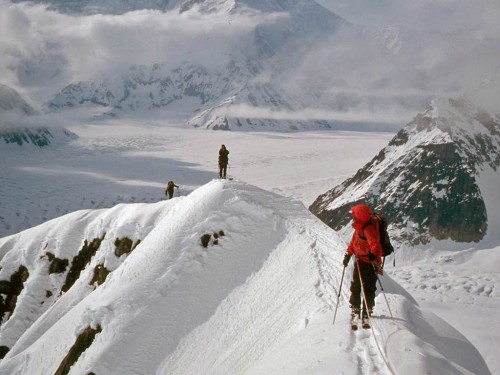
- Taking the morale high ground on avalanches by staying above their starting zone. Thunder Mountain, Alaska Range, AK. 2003
Between new safety technology and changes in attitudes, people are venturing into more committing avalanche terrain than ever before. In times past, avalanche education was as simple as telling skiers to stay out of avalanche terrain, which is still taught in parts of the world. It’s not a bad idea, but also not reality. What was once considered insane terrain is now skied before breakfast without a second thought. Skiers are becoming much more educated about avalanche danger, but at the same time they are cutting the safety margins down to the bare minimums.
______________________
For 15% off on a Patagonia Light Smoke Flash Jacket from Backcountry.com, click the photo below…