Archive for the '06 Downhill' Category

Chututorial 101

I happened to have my POV camera with me yesterday when I stumbled across the Holy Mole couloir, so I shot a little 10 minute “How I Ski Chutes” tutorial, or Chututorial.  Don’t get your Oscar nominating hopes up – it is pretty crude, but it does illustrate the thought process that goes into skiing a couloir, especially one that you haven’t climbed up from the bottom. Continue reading ‘Chututorial 101′

The McClean Turn

STOKAGE! Scot Schmidt has the Schmear Turn, the Eagen Brothers are credited with the “1-2-3 Turn” and Sylvan Sudan is synonymous with the Pedal Hop Turn, but until recently, all I had was a stupid website with a hard to spell url.  But no more.  In a bit of a backhanded compliment, the McClean Turn is now defined not by what it is, but what it is not.  From the original context:

Jer and I wanted to ride this with a unique touch. As much as I love the guy and respect everything he’s done, we did not want this to be an McClean 168cm hopped turned descent. We wanted to flash this thing. Edge to edge, continually and fast.

Continue reading ‘The McClean Turn’

Good Snow Hunting – Part I

The best bit of backcountry skiing insight I’ve ever gotten came from a friend who I don’t think has backcountry skied a day in his life.  Chris “GroFo” Grover is the Grand PoohBah of Sales at Black Diamond Equipment and has been quitting smoking for the last 15 years, which makes him wonderfully terse.  The topic came about as a group was gathered to discuss possible ideas for upcoming catalog articles, most of which were fairly lame. Out of nowhere, Grove spoke up.  “What I want to know is how to fucking find the best snow.  If I’m going to hike for two fucking hours, it fucking better be good.”
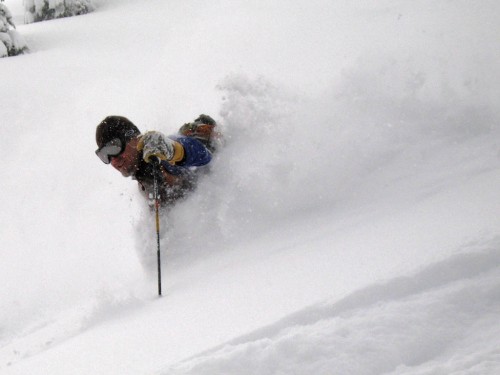
Bruce Edgerly busting pow on demand after a big dump.  On days like this, it is hard to go wrong with your choice of location.

Bruce Edgerly busting pow on demand after a big dump. On days like this, it is hard to go wrong with your choice of location.

Grove has a way with words and an excellent point.  Why would you hike for hours to ski crappy snow?  You wouldn’t – at least not more than a few times and finding good conditions is the essence of backcountry skiing. A key element to this question is defining “good snow” which is not always powder.  At times, corn snow, wind board, recrystalized powder, or chowder may be the best thing going at the moment, and knowing what is going to be good, and where to find it has everything to do with your backcountry satisfaction.

Weeks after the last snow and still skiing powder?  WTF?  How do you find this?

Weeks after the last snow and still skiing powder? WTF? How do you find this? Julia Niles doing what must be done - tracking it up.

 A big, fat dump of powder is almost the lowest common denominator of backcountry skiing as everything is going to be good.  What separates the savvy pros from the shut-out newbies is the idea of strategic thinking – given the current conditions, what is going to be good, and where do I find it?   There is always good skiing to be had in the backcountry, it is just a matter of knowing where and when to go.

To be continued all this week…

 ________________________________
Help support StraightChuter.com and ski with Julia’s pack of choice, the Mountain Hardwear Direttissima from Backcountry.com. Click on the photo below…

Steep Skiing 101 – Part IV

One reason there isn’t more super steep skiing footage in ski films isn’t that it is so hard to shoot, but more that it is kind of boring to watch. Slip, slip… slip.  Pause.  Turn!  Slip, slip, slip. Pause. It is way more fun to do than to watch. 

Jared Inouye keeping it under control just before the rap on the NW Couloir of the Pfiefferhorn.

Steep skiing is like this because when the stakes are high, it is important to make every turn count. The best way of doing this is to get every turn under control before committing to the next one.  Unlike moderate slopes where you can easily recover from getting back or inside, steep slopes have a way of magnifying imbalances.  Starting a turn from the backseat means you’ll land even more in the backseat and within one more turn, you’ll be checkin’ out. 

In good conditions, like half-inch deep corn, it is much easier to stick a turn in a perfectly balanced position and roll it over into the next one with almost no delay.  But, in icy or funky conditions, getting a turn under control may take 20-30 feet of nervous skittering around before you are ready for the next one.

Bean Bowers moments before taking a 300' whipper of a lifetime off the top of Gorra Blanca, Patagonia.

As with most things related to steep skiing, patience is important.  Don’t rush the dicey turns, enjoy the exposure, take it one turn at a time, and before you know it, you’ll be linking some big fat sweepers on run-out apron.

Edited to add this afermath photo of Bean’s whipper:

Bean at the bottom of his long fall. It was pure luck that he landed on this steep, soft slope. In retrospect, the fall was probably more than the 300' I mentioned as this photo just shows the lower 1/4 of it. I don't think I've ever asked Bean what was going through his mind when he was falling - I should.

________________________________
Help support StraightChuter.com and keep it under control with a pair of Scarpa Spirit 4 Alpine Touring Boots on sale now at Backcountry.com. Click on the photo below…

Steep Skiing 101 – Part III

Ninety-percent of steep skiing is in your head.  I’ve witnessed some absolutely crappy skiers make it down steep slopes and conversely, seen experienced skiers (including myself) totally freeze up.  It’s one of those things you just have to be psyched for and sometimes you are, and sometimes you aren’t.  A bitter divorce or break-up seems to help get people in the mood to ski like they just don’t care.

Pondering the likely outcome of the Kevorkian Kouloir - Baffin Island. Photo by Brad Barlage.

Good partners go a long ways towards successful steep descents.  On one hand, you want someone who is motivated and confidence inspiring, yet not over-bearing or pushy.  The last thing you need when faced with a potentially huge fall is peer pressure from a friend.  Aggressively nailing a steep line may be the ultimate goal, but if you didn’t have your Wheaties and don’t feel up for it, it is great to have an understanding partner who won’t give you shit for sideslipping the entire line.  What goes around comes around and it seems to happen to everyone.

Dylan Freed stepping lightly in the Great White Icicle, LCC.

A related aspect of mental warfare is the dreaded pre-psyche-out.  This often happens the night before when slopes grow teeth, sprout patches of glaze ice and steepen by 15 degrees.  By the time the sun comes up you’ve convinced yourself that you are about to die.  Reality is seldom this bad and a good mantra is “You never know until you go.”  If it really is horrible, turn around and ski another day.

________________________________
Help support StraightChuter.com and get some blood-stain resistant Mountain Hardwear Vertical Pants from Backcountry.com. Click on the photo below…
 

Steep Skiing 101 – Part II

Regardless of technique, one of the hardest things about steep skiing is committing to the first turn.  Unlike climbing where you start at the bottom and slowly gain more exposure as you go up, with steep skiing, you are looking at the taking the maximum whipper if you blow the first move.  I personally love this aspect of the sport.  :)

The first turn with no warm-up and maximum exposure = no mercy.

There are a bunch of tricks to taking the sting out of the first turn.  My favorite, if it is at all possible, is to find a descent which allows you to make a few warm-up turns before getting down to business.  This is especially important with backcountry skiing as something like a boot left in tour mode or snagging a pole on a pack strap can ruin your day.  Even if it is just a turn or two, try to reef on your gear as much as possible just to make sure everything is buttoned up tight.

Technique-wise, Hilaree O’Neill had a great tip, which was to make a modified Stem Christie turn.  Stem Christies, in case you have forgotten, are snowplow turns, then going back to parallel skis in between.  This technique works as it forces your body out and over your skis in a controlled manner and gets you moving downhill.  It is also a good technique in deep or heavy snow when you might have trouble “clearing” your skis from the snowpack.  Once you get moving, you tend to stay on top, so it is mainly just the first turn that needs to be done this way.

Derek Weiss with a lot on his mind in the Cortex Couloir, Great Basin National Park, NV.

But, more than anything, the first turn is a game of mental warfare, especially if you are staring at a 3,000′ void.  The key is to relax.  Remind yourself that you are here because you want to be (hopefully) and that you have made millions of turns before and this one will be no different (hopefully).  Even though your mind may be firing hard on all cylinders, try to take a breath, relax, clear your mind of everything… and just do it.  If it goes well (hopefully) every turn gets a little bit easier and after you’ve made a dozen or so, the fear has subsided and the skiing becomes a blast.

________________________________
Help support StraightChuter.com and keep your head together with a Petzl Ecrin Roc Climbing Helmet on sale now at Backcountry.com. Click on the photo below…
 

Steep Skiing 101

Wasatch Weekend Update: Way better than expected!  After two weeks of warm temps, howling wind and no snow, the backcountry still had some soft and fun skiing.

I had a good time at The Big LePowSki event this weekend, where one of the clinics I taught was “How to Assess and Ski the Steeps.”   As much as I love steep skiing, I’ve never put much thought into how to actually teach it, so it was a fun learning experience for me as well.  First off, don’t fall.

DJ Dylan Freed showing how its done in Iceland.

DJ Dylan Freed showing how its done in Iceland.

There have been various semi-popular steep skiing techniques over the years, including the Schmear Turn, the Pedal Hop Turn, the 1-2-3 Turn and the classic over exaggerated double-pole plant turn.  Personally, instead of adding anything extra to a basic parallel turn for steep skiing, I like to strip it down to its absolute bare minimum. This means shoulders square to the fall-line, hands forward, weight on the balls of your feet, keeping your upper body as quiet as possible and doing all of the turning from your waist down.  In a nutshell, this is basically a hop turn, which can be easily practiced on almost any slope angle.

Setting up for a steep turn in Iceland. Photo by Matt Turley.

In the right conditions, one of the coolest things about steep skiing is that it can almost be effortless as you hardly need to unweight at all to send yourself flying into space on a 50-degree slope.  Once you unweight, there is a brief moment when you are suspended above the snow, facing straight down the hill and completely airborne.  This is the stuff that causes people to become terminal ski bums.

To be continued tomorrow…

________________________________
Help support StraightChuter.com and get a grip on the steeps with a pair of Mountain Hardwear Torsion Gloves on sale now at Backcountry.com. Click on the photo below…

Self Retrieving Ski Anchor

I learned this sketchy rappel technique, where else, but in France, although in all fairness, it was a Swede who showed it to me.  The idea is that with nothing more than a length of rope, you can set up a rappel in the middle of a snowfield, then after you’ve rappel, you can pull on the other end of the rope and get the anchor to release.  The advantage of this is that you don’t need to find a tree, picket or anything else for an anchor.  The disadvantage is that it is NOT a super reliable rappel anchor and at times it can have trouble releasing if you bury your skis too deep.  Still, when it works it is pretty cool.

I’ve only set this up once and found that it works well in a pinch when you want a little extra security on a slope that might be a dangerous down-climb.  It is not the rappel of choice for a high-stakes, free-hanging rappel! 

This technique is a variation on a self retrieving ice axe rappel, which substitutes axes for skis.  A key part of this rappelling technique is to have holes in your ski tips, as you need to pass the rope through them.  (Yet another reason to have holes in your tips…)

Step One – Dig a trench one ski width wide with a shallow pocket in the back.

Step Two – Lay one ski horizontally in the trench, then stuff the other ski vertically in behind it.  Make sure the skis are base-to-base and the horizontal ski has its tip pointing downhill.

Using a bowline, tie a loop around the upright ski, then pass the other end of the rope through the horizontal ski, tie an overhand knot,  add in about six feet of slack, pass the rope through the ski tip of the vertical ski and tie another overhand knot.

Step Three – Rappel very gently, making sure not to pull on the uphill side of the rope.

Step Four – When you reach the bottom of the rope loop, auger in and pull the other end of the rope.  Hopefully this will get the horizontal ski to pop loose from its bed and come out.

Step Five – Keep pulling.  Hopefully the horizontal ski will pop loose, followed by the vertical ski.  If this works, heads up!  A mess of rope and skis will come tumbling down.  If it doesn’t work… bummer.  You might have to climb back up and rerig it, but now your anchor is perhaps compromised.

If it works, don’t tell your Mom about it – it will only make her worry.

 ________________________________
Help support StraightChuter.com and rap ready Beal Rando 30 Rope from Backcountry.com! Click on the photo below…

The Simple & Sexy Munter Hitch

The Munter hitch is perfectly suited for ski mountaineering as it is simple, only requires a locking carabiner, can be fed quickly (for belayed skiing) and is reversible for belaying or rappelling.  Also, unlike many belay devices, it works well with smaller diameter ropes.  The downside of it is that it requires constant brake-hand pressure, so if you let go, you can easily drop yourself or the person you are belaying.  It also kinks ropes, but for the occasional ski mountaineering belay/rappel, that’s a small price to pay.

The glorious little Munter hitch

Continue reading ‘The Simple & Sexy Munter Hitch’

Rap Master

If you suspect that a ski descent might require a rappel, it is a good idea to bring a small assortment of gear in case you have to set an anchor.  Trees and rock outcroppings are the best anchors if you can find them, but often times it’s necessary to whack in a piton, Stopper or cam to create a secure point to rappel from.  The amount of gear you need for setting anchors varies, but 10 or so pieces ranging from knifeblade pitons to fist sized cams will get you through, over and around almost any obstacle.

The best gear to use for anchors is your oldest and least valuable, as it will become one with the mountain.  Bring along an ice ax with a hammer on it to apply a little extra lovin’ to those tight fitting pieces and remember, your life is worth far more than a few old nuts and cams.  When it doubt, back up your rap anchor with extra pieces.

Here’s a sample rap kit:

Rap gear

1.   8mm x 30m (or thicker/longer) rope
2.   Full-length runner. Good for looping over rocks
3.   25′ of 6mm accessory cord. Can be chopped up, or used to extend anchor points.
4.   22cm ice screw. A good anchor itself, or useful for making V-Threads
5.   Pitons – these go in when nothing else will and create excellent anchors
6.   Stoppers and/or nuts. The best bang for your rappelling dollar.
7.   Cams – at times, these work when nothing else will.
8.   Carabiners – used to connect anchor points, or as the main rappel point (doubled-up)
9.   Locking ‘biner – needed for a Munter Hitch rappel
10. Harness – the simpler, the better.

Keep the rock gear organized on the full-length runner and packed in a small stuff sack so that it doesn’t shred everything inside your pack and is ready to go.  If you think you are going to rap, put your harness on before dropping in so you don’t have to do it while you’re sketched out on top of a big drop.

 Packed Rap kit

 ___________________________________
Rap Gear from Backcountry.com at 15% off:

Beal 30m Rando Rope – compact and perfect for ski mountaineering.

Petzl Attache Locking Carabiner – smooth, strong and small.

Petzl locking Biner