Archive for the '05 Uphill' Category

Page 2 of 3

Steep Skinning – Gear Adjustment

You don’t need any special gear to lay down a steep skin track, but there are a few adjustments you can make to your existing set-up which will help.

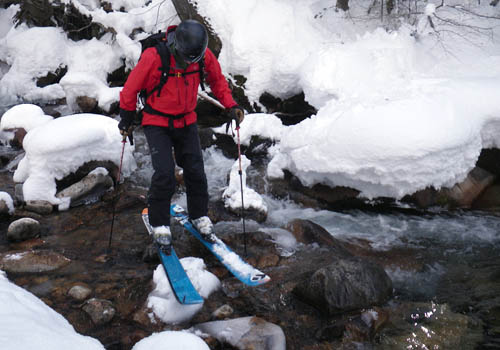
Heel lifters are absolutely essential and should be turned to their highest setting.  Don’t be bashful. Certified guides dislike heel lifters for their clients as they are too tippy, but once you get the feel of them, there is no going back.  It’s kind of like walking around on a roof with high-heels – it may not seem like a good idea, but it keeps your foot flat so you can use your thigh muscles instead of your calves.

Lifters up, poles down, feet flat. Go dog go.

Shorten your poles down so you can get on top of them instead of hanging off of them.  Pushing on them instead of pulling allows you to use your arms, chest and back instead of just your arms.  It is the difference between doing push-ups and pull-ups.  I can do little cheater push-ups all day long but am cooked after about ten pull-ups. If you have asymmetrical baskets (and you should), rotate them with the short side forward so they don’t lever out.

Get some good nylon skins.  Nylons are known for their sticky climbing abilities and that’s what we are talkin’ about here. Good glue and a tip & tail kit are also important for steep skinning as you put a lot more sheering force on your skins than when you are just scooting along on the flats.

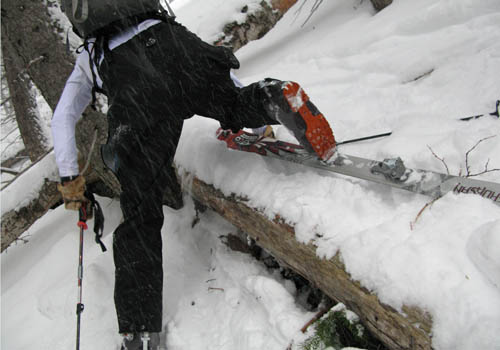
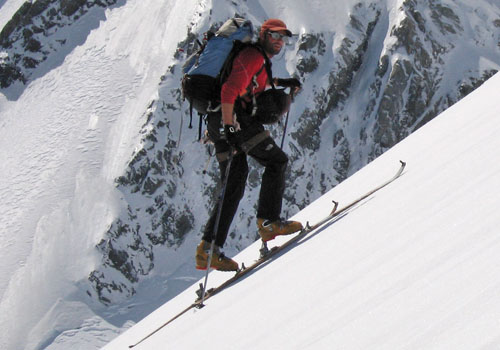
LG working it out in Alaska.

LG setting a 40 degree track in AK.

Undo your top boot buckles so you have maximum ankle flex.  I usually keep my forefoot buckle fairly tight (as tight as I’d have it for skiing), the ankle buckle semi tight and totally undo the top buckle.  I don’t use the Velcro powerstrap, but if I did, I’d loosen that all the way as well.  Of course, make sure your boots are in tour, not ski, mode. Like friction climbing, steep skinning requires a subtle feel and you want control without restriction from your boots.
________________________________
Help support StraightChuter.com and get on top of a Black Diamond Whippet Self Arrest Pole on sale now at Backcountry.com. Click on the photo below…

Steep Skinning – Part 1

Spring is here and the time is right for skinning in your top pegs.  I don’t go out of my way to always pick the steepest skin line possible, but there are times, actually, a lot of times, where a steep skin track angle is much safer, faster and more efficient.

Few things in backcountry skiing piss people off more than a steep skin track, but that is probably because they don’t know how to ascend it properly. Once you get the hang of it (details to follow in this week’s postings), setting a steep track can be way faster than wandering all over the hillside at the prescribed 12-degree perfect angle.

Lorne Glick busting out a steep one on Thunder Mountain, Alaska. This direct line hit 40 degrees in places and kept us out of avalanche starting zones.

A few steep skinning myths:

A lower angle skin track is more efficient.  
Not so.  Walking up a low angle handicap access ramp is technically easier step-by-step, but no more efficient than going straight up a flight of stairs.  It takes a set amount of energy to climb a mountain and the variables are time and distance traveled. 

The fastest racers in world all use lower angle skin tracks.
True, but that has as much to do with using bindings which only have one elevation setting and skins which glide better than they climb.  The top guys/girls are also plenty speedy on steep tracks as well.

Steep tracks are set my macho jerks with something to prove.
Perhaps.  Then again, maybe they are setting a steep track as an ability barrier to keep a powder stash from being overrun once the track is in.  If people can’t get up, they can’t ski down.  See the “no friends on a powder day” rule for further clarification.

________________________________
Help support StraightChuter.com and bust out a steep one with Black Diamond GlideLite Nylon STS Skins on sale now at Backcountry.com. Click on the photo below…
 

Skinning in the Sandbox

While skinning up Argenta today I was reminded of the term “skinning in a sandbox.”  About the only silver lining on this condition is the apt and funny mental imagery of actually skinning uphill in a sandbox, but aside from that, it is a very frustrating experience.  What makes it so annoying is that it is not the skins that are slipping (although it feels like it), but the snow sheering on itself.  This condition often happens when surface hoar crystals start to get as big as potato chips (as is happening now in the Wasatch), or when the top layer in the snowpack becomes very faceted and rotten, which is also happening.

Julia Niles chillin' on the skinner. Don't worry, be happy.

There are three things that can be done to alleviate the misery;

  1. Cut your skin angle down.  I love my high pegs as much as the next skinner, but you can’t sink the spurs into the track angle if the snow itself is sheering. 
  2. Concentrate on establishing your uphill, inside edge with each step.  Skinning is just the opposite of skiing and your uphill, inside edge is your “control” edge.
  3. Be patient.  Mellow out.  Relax.  Hum a little tune.  You aren’t going anywhere fast.

There is also a popular forth option, which is to blame it on someone, like the Finns or Norwegians.  :)
________________________________
Help support StraightChuter.com and smile like Julia in a pair of Mountain Hardwear Women’s Sychro Pants from Backcountry.com. Click on the photo below…

Skinning Outside the Box

A common skinning malady is to turf face-first just as you are committing to an uphill kickturn on a steep, greasy switchback.  This can be fun the first few times it happens, but gets old quickly and can be easily remedied. 

A minty-fresh uphill kickturn, or switchback. They don't stay like this for long.

Over time, skin tracks get beat-out for a variety of reasons.  One of the main culprits is when subsequent skinners come up a few inches short of the turning point and instead of taking a six-inch baby step, they rush the turn, which essentially makes it steeper than it already is.  Another common problem with switchbacks (especially steep ones), is that people stomp their skins to help set them before starting the turn, which further steepens the track by creating divots that have to be climbed out of.  But, none of this matters as there is a way around this turf-fest. 

An exaggerated view of a beat-out switchback.

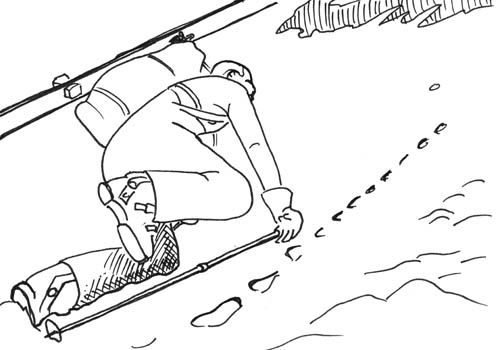
The solution involves two simple steps.  The first is to go deeper into the kickturn “box” (an unofficial term) such that you are overshooting the switchback to the point that your lower boot is now even with the upper track (#1 below).  After this, with your new leading foot, step DOWN across the skin track (#2 below) instead of stepping directly into the skin track.  This gives you a nice solid platform so that now, as you bring your new ski around, you can step back into the track and be on your greasy way.

________________________________
Help support StraightChuter.com and stop a bloody nose after a switchback attack with an Adventure Medical Ultralight Traveler First Aid Kit from Backcountry.com. Click on the photo below…

Death by a Thousand Missteps

I’m always tormented when I see ragged skin tracks as I feel compelled to say something, yet at the same time it’s hard not to come across as being rude.  “Excuse me my friend, but do you know your skinning technique is all phucked up?”  It’s kind of like seeing someone with an open fly – maybe they like it that way and it is none of my business.  ??  In any case, having an efficient stride is way more important than owning the lightest, sexiest gear as an inefficient stride burns up far more energy than just gliding along.
Exhibit A - lift & seperate works well for somethings, but not skinning.

Exhibit A - Lift & Separate works well for somethings, but not skinning.

The Good, The Bad and The Ugly.  Slide & glide is ideal. Slide & stomp is, uhmmm, not so good. Romp & Stomp should be left to the Rec Room.

The Good, The Bad and The Ugly. Slide & Glide is ideal. Slide & Stomp is, uhmmm, not so good. Romp & Stomp should be left to the Rec Room.

Two friends go skinning... the one on the left is working much harder than the one on the right.

Two friends go skinning... the one on the left is working much harder than the one on the right.

There are many potential reasons for ragged skinning technique including mis-mounted bindings, blown boot cant adjustment or just natural physiology.  The first thing to do is just be cognizant of it, which usually fixes the problem and then with enough thought and practice, an efficient stride becomes habit.  Think of two pointy arrows sliding in parallel over the snow.

________________________________
Help support StraightChuter.com and slide along with a pair of Scarpa F3 Alpine Touring Boots from Backcountry.com. Click on the photo below…
 

It’s All About the Up

Coming from an alpine skiing background, it took me a few years to warm up to the idea of backcountry skiing. It didn’t help that the guy I learned how to backcountry ski from was wicked-fast, which meant my early outings were exhausting efforts of trying to keep up where all I could think was “I’m cooked. We only made five runs today and I could have done five times that at Solitude.” I kept a season’s pass in reserve until one day we skied Lisa Falls in thigh-deep sub 5% powder, which set the backcountry hook for once and all. Since then I’ve done way more backcountry skiing than riding the wire, and like any addictive substance, the further you get from it, the less you miss it. As cyclist Greg LeMond said “It doesn’t get any easier, you just get faster.”

Mona Lisa Falls Overdrive. You can't get there by helicopter, sled or chairlift. Alex Lowe points the way towards 5,000' of pure fluff.

The key to enjoying the hiking/touring aspect of backcountry skiing is to do it enough that you find your own rhythm and stop fighting the pain. I think of it like mountain biking, trail running or rock climbing – the uphill exertion part is a fun challenge and the downhill is the icing on the cake. Human powered ascent gets easier the more you do it and at some point it becomes fun in itself. Beyond that, when you start to mix in route finding, team work, trail breaking and avalanche assessment, the ascent becomes an intricate challenge with the final skin track becoming a piece of backcountry artwork. Skin tracks are a reflection of the people who put them up, and like reading a good book, a tight skin track makes you want to meet its author. “Hmmm, three people swapping leads with no breaks, full heel pegs, tight switchbacks around the rocks, nice cornice stomping and they avoided that fat pillow – must be Derek and Co. Very nice.”
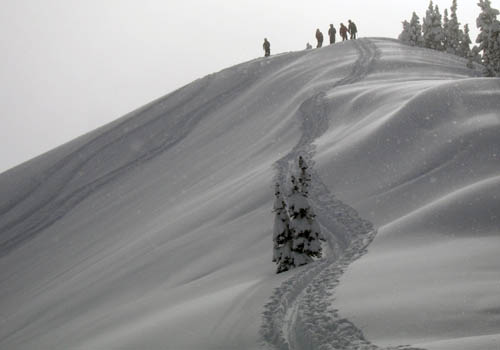
Tight tracks up Tanners.  Skinning and photographic artists unknown.

Tight tracks up Tanners. Skinning and photographic artists unknown.

I love the up.

________________________________
Help support StraightChuter.com and learn to love the up with Black Diamond Ascension Nylon STS Skins from Backcountry.com. Click on the photo below…

Skin Set Up – Part Two

Now that the edges have been trimmed back and the nose has been set, I like to tweak my tails a bit (the tails of the skins that is).

Although I designed the BD ClipFix and used that system for years, I’ve now gravitated towards the STS system (shown below).  I liked the ClipFix, but as Martin Volken said about it, “It’s an expert system.” meaning if you spent the time to get it perfectly dialed, it worked great, but if not, they’d fall off. I didn’t mind getting mine dialed in, but that often meant widening the tail slot, which is/was kind of a pain.  The STS system is not only totally bomber, but it fits most of the standard issue tail notches.  If you don’t have a notch, most skis can stand one being filed/cut in and it makes a huge difference in keeping your skins on.

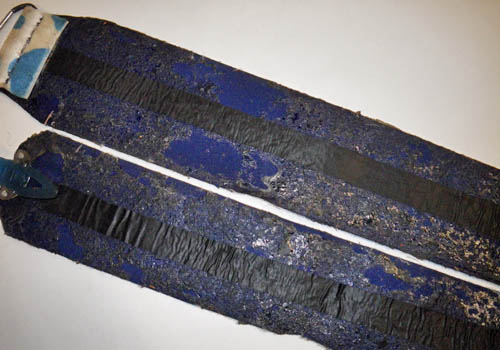
I use a pair of Channel Lock pliers to crimp the camming cleat down to a lower profile (less chance of it getting hung up on things) and then thread the tail back through the tip, as shown above.  Tucking the tail up makes for cleaner, faster uphill kick-turns where you are less likely to step on your tail dingle.  Plus I hate having those things flapping around.

As a final skin set-up step, I keep the skins attached to the appropriate ski with a Voile strap so I never grab the wrong skins, or worse yet, forget them, when heading out the door for a big powder day.


________________________________
Help support StraightChuter.com and pick up a pair of the light & compact Black Diamond GlideLite Nylon STS Skins from Backcountry.com. Click on the photo below…

Skin Set Up – Part One

I’m the first to admit that I’m anal-retentive when it comes to setting up my skins.  Why? Because spending an hour or so in the beginning getting your skins just right means you never have to fool with them again and that they seldom fall off or fail in the field.  I can’t remember the last time I had a skin failure.  Once skins are properly trimmed and adjusted, they can take all sorts of abuse, such as walking across rocks, asphalt and logs.

One of the most important parts of trimming out a pair of skins is to hold them back about 3/16″ from the edges.  Many people just trim them “neat” to the edges (as much out of laziness as anything), but that makes it much harder to get the skins on the ski and you lose your sharp edge when you need it on firm snow.  The tiny bit of extra grip you’ll get by going wall-to-wall is irrelevant compared to the problems it causes.

To trim the edge back, first trim it “neat” to the edges, then move the skin over so about 3/16″ of an inch is hanging over, trim it off, then do the other side.
An expert skier/skinner with full-width skins being humbled into a self arrest on an icy slope as he couldn’t sink an edge in. I’m glad you were okay Steve. ;)

On the tip, if I think there is any chance I might adjust the length of the skin, I use a rounded end.  This gives a bit more adhesive-to-adhesive contact, plus it allows the sides of the skin to grip a bit more, which helps to keep snow from packing in there (the beginning of the end).  As most of my skis have dedicated skins, I cut the tip off short and sew it tight with some beefy thread.  This ensures that the tip loop never comes off, gives a nice smooth contact profile to the skin and saves a bit of weight & bulk.

On skins which are dedicated to a certain pair of skis, I cut the nose short, then stitch it on as shown on the left. On skins that may change skis, I trim the nose with a half circle (as shown on the right).

________________________________
Help support StraightChuter.com and pick up my current skin of choice, the Black Diamond Ascension Nylon STS Skin from Backcountry.com. Click on the photo below…

Pick Your Poison – Methods of Ascent (part II)

Learning to skin is like learning the alphabet-something you have to do before you start spelling words or linking tours together.  It’s a lot like walking, but a bit different. Booting is walking, but unless you are on firm snow, your range will be severely limited as nothing saps your energy like post-holing in deep snow.  Snowshoes can be learned via The Twelve Step Program (take twelve steps – now you are an expert), but they lack any sort of glide and don’t climb very well, or if they do, then they don’t float very well.  Snowshoes are popular with snowboarders, but eventually, if the boarder is serious about getting deep into the backcountry, she’ll switch over to approach skis or split boards.
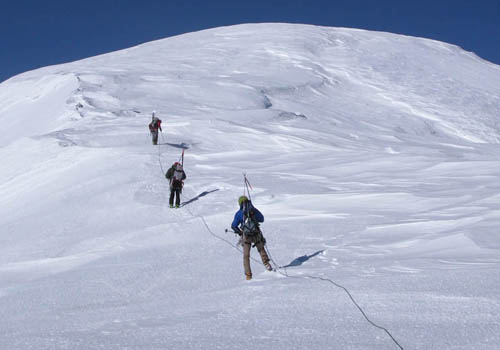
Skin if you can... boot if you must.  Greg VonDoersten punching out the final feet to the summit of Mt. Damavand, Iran.
Skin if you can… boot if you must. Greg “GVD” VonDoersten punching out the final feet to the summit of Mt. Damavand, Iran.


Skinning is the most complicated method of the three, as it requires not only the skins, but a touring binding as well and a tad of technique. Still, these are very small prices to pay if you are planning on touring more than once or twice.

________________________________
Help support StraightChuter.com and be like GVD with a Patagonia Beanie from Backcountry.com! Click on the photo below…

Pick Your Poison – Methods of Ascent

For ski mountaineering, there are three main methods of traveling over snow; skinning, booting or snowshoeing.  Of these three, skinning is by far and away the most efficient and versatile.  Booting works well when there is an existing boot track, or when the going gets steep.  Snowshoes are better than crawling, but not by much.  Regardless of which method you choose, a critical factor is that everyone in your group uses the same system as the pace and route selection is radically different with each one.  A skin track will wander much more than a boot track and snowshoes will be somewhere in-between.  If you find yourself in a mixed group, the first discussion you should have is where, or if, you will regroup when your party gets separated, because they soon will. 
Birds of a skinning feather... stay together.  Sol Mountain Lodge, Monashees, BC
Birds of a skinning feather… stay together. Sol Mountain Lodge, Monashees, BC


Continued tomorrow…

 ________________________________
Help support StraightChuter.com and get the vertical munching Ascension Nylon STS Skins from Backcountry.com! Click on the photo below…