Archive for the '05 Uphill' Category

Keep’er Steeper Skinning

The other day I was out skiing with a woman I didn’t know very well and she mentioned something about “macho assholes who set steep skin tracks.”   Good thing it wasn’t a first date as she was most likely talking about me.  I love steep skin tracks in the same way that I love steep, run-out friction climbing.  It’s a fun physical and mental challenge that gets easier the more you do it and at some point it just becomes normal. Continue reading ‘Keep’er Steeper Skinning’

Creek Crossings

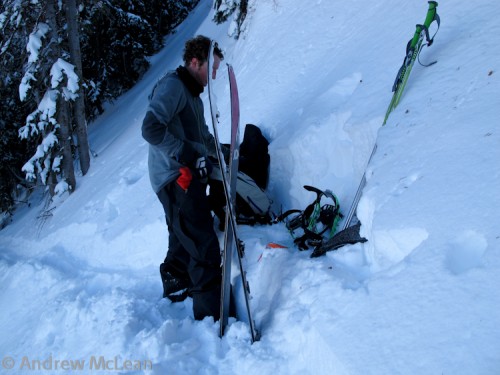
I first got into crossing streams with my skis on by accident when I was trying to cross over a slender snowbridge which collapsed and dumped me in the stream.  I was mainly worried about scrapping up my bases and edges, but on the other-hand, my feet stayed dry and it was fairly secure, so now I do it intentionally.  The rocks tend to have some river slime on them, so they are pretty easy on your edges and bases, especially if you just step and don’t slide on them. Continue reading ‘Creek Crossings’

150lb Crusts & The Alpine Crawl

One of the more frustrating booting scenarios is when you encounter crusts which are almost supportable… but not quite.  Since I weigh in at about 165lbs with all of my ski gear, I think refer to these crusts by the amount of weight they will support. One-hundred and fifty pound crust is my nemesis as it is just enough to allow me to commit to a step and push up on it before it collapses and I sink in to my groin.  Hateful.  I’ve been out on many occasions where I’ve been able to boot up something, but my heavier partners are wallowing in misery behind me as they punch through every step.  This is usually only funny when it is happening to someone else.

The cure for crust is the Alpine Crawl, which is preformed just like you might imagine, by crawling up a slope on your hands and knees.  There is some booting involved, but the idea is to spread your weight out over your hands and shins so you get a little bit of extra flotation.

You can motor right along with an Alpine Crawl, but it gets tiring.  Fortunately, that perfectly awful zone never seems to last too long – it either tightens up and become supportable 200lb crust, or softens up to the point where it might be easier to switch back to skins. In the meantime, get on your knees and crawl. Continue reading ’150lb Crusts & The Alpine Crawl’

Glue Renew Guru

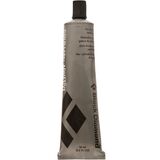
I love the idea of regluing skins, not just because it is all eco earth friendly and vegan approved, but because a pair of moderately worn nylon skins have such a nice feel to them – they glide, climb and fold-up like butter.  With this in mind, I stripped the old glue off of a pair of skins last year and carefully documented my first outing with Black Diamond Glue Renew strips in eager anticipation of a KILLER BLOG POSTING.  Yeah, well, it turned out like crap as I have the patience of a two year old and once again forgot to read the instructions until after I finished the job. Continue reading ‘Glue Renew Guru’

Video – Skin Ripping

A little video we shot this morning while waiting (and waiting…) for it to finally snow in the Wasatch. This technique is a slo-mo variation on a racing strip and it takes about one and a half minutes. Out of habit, I like to strip my skins right when I get to the top of a climb just so that I’m all ready to go. After that, I can, and usually do, dink around for a while, but first things first.

________________________________
Help support StraightChuter.com and stuff your stuff in a Mountain Hardwear Wayback Backpack from Backcountry.com. Click on the photo below…

Skinning Over Timber

I tend to do a lot of skinning over timber.  Why, I’m not sure as it is not really that much fun, but I suppose it is better than traversing way around a fallen tree, then backtracking.  Timber skinning is especially common early in the season or when it is a low snow year, such as we have now (sniff…). Continue reading ‘Skinning Over Timber’

Favorite Glacier Rope

I’m slowly assembling my Antarctica kit and pulled out my favorite glacier rope tonight.  The sad thing is, I don’t even know the brand, but it doesn’t really matter – what is important is my fast and easy, do-it-yourself modification.  Starting with a 60m dry 9.1mm’ish rope, find the center, apply a sharp blade to it, and turn it into two ropes.  (That is, two 30m ropes, not two 60m 4.5mm ropes.)

There are a ton of advantages to having two similar/identical 30m ropes for glacier travel, but the main thing is flexibility.  You can travel with four people on a 30m, or break into two groups of two each with their own 30, or clip two ends to the middle person and go three or five on a 60, or leave one section in camp if you don’t think you’ll need it, or coil one 30m section up and bury it in a pack if you are traveling tight and fast… and many other options.  You can also do the same length rappel with as you would anyway (30m) by tying the two sections together.  The one big disadvantage is that you lose the ability to lead 60m pitches with gear placements (the knot won’t pass through biners), but that usually isn’t a big concern with ski mountaineering.  One the positive side, since 9.1′s are a bit sketchy for taking big whippers on (at least mine is), you can double up on the ropes and still lead 30m pitches. Continue reading ‘Favorite Glacier Rope’

Choosing Climbing Skins

There are many variations on the skin theme available nowadays – nylon, mohair, mixed, hybrids, domestic, European, tip catchers, tail rippers, no tails and everything in between.  I’m partial and opinionated about what I like for the Wasatch, but am the first to admit that the best skin for the job is probably whatever the locals use in a given area.  First off, the locals are bound to know their snowpack and what skins work best on it, and secondly, their skin tracks are going to reflect that.  When Europeans bring narrow mohair skins to the Wasatch with no tip or tail loop, they inevitably get frustrated with the steep skin tracks and then the cold, dry air causes their glue to fail and their skins fall off.  Conversely, bringing a pair of burly nylon skins to Europe would be like walking around with sandpaper on your skis as the snow pack and skin track favor the gliding properties of mohair. Continue reading ‘Choosing Climbing Skins’

Steep Skinning – Mindset

Having the right mindset is almost as important as the right gear and technique when it comes to steep skinning.  You have to be into it.  I was out touring with a friend from Switzerland in the Wasatch Mountains a few years ago and he refused to follow any of the existing skin tracks, which tend to be steep (from what I’ve heard from out-of-state visitors – they seem normal to me).  “These skin tracks are stupid!”  We ended up breaking new trails, which is about the worst that can happen if you can’t or don’t want to push the angle.  So what, eh?

Another little trick is to be calm a subtle with your footwork and try to milk every little irregularity you can.  Put your ski/skin down once, pressure it firmly and stand up on it smoothly.  Stomping rarely helps and more often than not destroys any grip the snow might have.


Perhaps one of the reasons I like steep skinning is that I also like friction climbing (moderate angle, smooth slabs, minimal handholds).  I was a little insulted when a friend once said “Oh yeah, friction climbing – whatever.  Once you get the hang of that you can hike routes all day long.” which is kind of true.  More than anything it is about developing a feel for the rock or snow, trusting your feet and relaxing.  Once you get comfortable with these elements, you can hike steep skin tracks all day long.

________________________________
Help support StraightChuter.com and get your groove on with Black Diamond Ascension Nylon STS Skins on sale now at Backcountry.com. Click on the photo below…

Steep Skinning – Technique

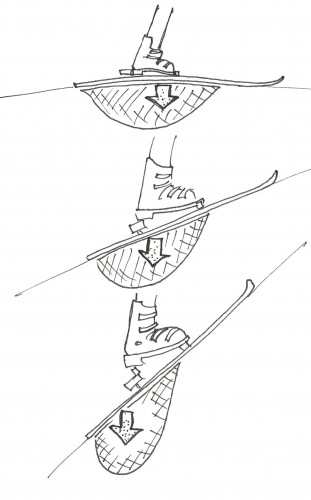
The technique for steep skinning is just the opposite of skiing, which makes sense as you are going up, not down. One of the harder things to get the hang of is the idea of leaning back, not forward.  Because touring bindings have a pivoting toe, it is hard, if not impossible to pressure the tip of the ski while in tour mode, which means you can’t press the skin’s nap into the snow.  Because of this, all of your grip comes from your toepieces back, so you want to make sure that is where your weight is. 

Chris Figenshau skinning up a 34-degree icy slope in New Zealand with textbook perfect style. Not bad for a photo dude from J-Hole. Good job Figs.

  1. Keep your back straight – don’t bend/break at the waist
  2. Keep your skis as flat as possible on the snow to maximize the surface area
  3. Press through your heels (important)
  4. Plant your poles near to your toepieces – not too far forward or off to the side.
  5. Stay off of your edges.  If you need to move sideways, “crab” to the left or right by moving your entire ski instead of trying to edge.
  6. Look up and forward, not down at your boots.  As the Bloodhound Gang song goes – “Lift your head up high and blow your brains out.”  Steep skinning may be painful until you get the hang of it, but it also gets you places in a hurry.

If you find yourself slipping, try lifting your big toe.  This is hard to do if you are leaning forward, (so lean back) and it will help shift your weight to the aft.  It’s like hitting the brakes.
________________________________
Help support StraightChuter.com and crank on up with Dynafit TLT Vertical ST Bindings from Backcountry.com. Click on the photo below…