Archive for the 'Gear Reviews' Category

HotWire History

I recently saw that Outside Magazine had voted the HotWire carabiner as one of the most influential pieces of gear of all time, which was a delayed honor as I designed the HotWire 18 years ago when I was working at Black Diamond Equipment.  I first started working at BD right after they had broken off from Patagonia/Chouinard Equipment as a result of selling them my design for a three pointed climbing hook called the Talon. At the time, BD had less than 40 employees and a big selling point to hiring me was that I could not only provide my own Compaq 386 computer, but also had a legal copy of AutoCAD. My first official project was a redesign of the Talon, followed by a slight redesign of the Quicksilver carabiner.  After that, we started on a whole new carabiner whose entire product brief was something along the lines of “make a really cool, super strong, lightweight sport climbing carabiner.”

Having grown up sailing in Seattle with my dad, I was familiar with wire gate carabiners as they’re very common in the maritime industry, so when it came to the “lightweight” part of the product description, this seemed obvious. The first prototype I made of the wiregate carabiner involved hand bending a piece of “piano wire” from a hobby store and milling the body out from a solid billet of some exotic military grade mystery metal that a supplier had sent us.  I printed out drawings of the design and spray mounted them to the metal as a template for cutting and remember going through about 50 endmills as the material was so gummy and unmachinable.


HotWire Prototype #001 circa 1994

Between the crude prototyping and horrible gate action, this first prototype was greeted with almost universal disdain by everyone except Johnny Woodward.  Johnny was also a Designer at BD, as well as having a background in math and being an incredible climber. At the time, the hallmark of BD carabiners was that the gate action was “as smooth as a BMW’s transmission” and Johnny was the guy who actually dissected the pivot points and geometry of the wire gate to understand why it worked and how to optimize it. He also realized that with less mass, a wiregate biner wouldn’t be as susceptible to gate whiplash, which can lead to carabiners being loaded in the “open gate” mode, which can reduce their strength from 25kN to 7kN. To prove this, Johnny mounted carabiners on a pivot and used high-speed photography to show beyond a doubt that a wiregate closed in a fraction of the time that it took a standard gate to retract.


A classic photo of Johnny Woodward on “Beau Geste.”

The wiregate idea was dropped from the immediate carabiner design, which eventually turned into Black Diamond’s first hot forged carabiner, The Fin. The Fin was intended as a sport climbing specific biner, but after it was introduced it became obvious that it had been designed and tested by people with large hands and was ridiculously oversized.  It died a fairly quick death, but the namesake “fin” on the back spine eventually resurfaced on the LiveWire biner years later.


The short-lived “Fin” carabiner – so large you could fly a Space Shuttle through it.

Meanwhile, Johnny was still interested in the wiregate concept and it was decided that if we were going to make a wiregate biner, it needed to have its own body as the tail sections of existing biners was too small to house two holes.  This was the official start of the HotWire biner and it took roughly a full year and 15 prototypes to dial in these two simple parts – the body and the gate.

Even after all the weights, strengths, functions, manufacturing and price issues had been resolved, there was still a large degree of skepticism about the biner and it was commonly referred to as “the paperclip gate” as it looked so weird. I distinctly remember the disappointment of hearing the pre-sales projection numbers before the  HotWire was introduced as they were a tiny fraction of the numbers for the best selling Ovals, Light D’s and Quicksilvers.  It was almost seen as a novelty biner with a host of unforeseen issues, like ropes being cut when it was cross-loaded (unfounded), gates losing their action or worst of all, general rejection by climbers.

Instead, what happened was that experienced climbers started using a few of them and realized that wiregate made an Aid rack lighter, they didn’t jam in the snow for alpine climbing, they were easier to clip for sport climbing, and best of all, there were no cut ropes or widespread failures.  After that, the wiregate concept basically sold itself.


The modern day HotWire carabiner, which has been through a few redesigns since the mid 90′s.

For the first few years the HotWire had a “Pat. Pending” stamp on it, which was a crafty move on BD’s part. While wiregates may have been new to climbing, as other carabiner manufacturers pointed out, they were hardly a new invention, so how could they be patented? Good question, but is it worth sinking a bunch of time, effort and money into a project knowing that you might be infringing on a patent? Considering that the patent process can take years, especially if the applicants want it to, and gearing up to design and make a wiregate from scratch could take years, there were no other wiregates on the market for many seasons. The patent itself turned out to be on the riveting process for the two ends of the gate, and although I don’t know if it was ever granted, it served its purpose of holding off the competition, at least for a little while.

________________________________
Help support StraightChuter.com and get the new & improved Black Diamond HotWire Carabiner ON SALE NOW from Backcountry.com. Click on the photo below…

The Elusive Pot Parka

I was checking out Forrest McCarthy’s ultralight gear list from his recent sufferfest on the Alaska Mountain Wilderness Ski  Classic, and was surprised to see that a pot parka made the cut.  I’ve been using them for years and haven’t been able to find them any more, so I was especially psyched to see that he even had a link for new ones at Liberty Mountain.

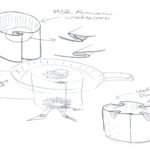
The pot parkas themselves are basically just an asbestos (?) cover that you put over your pot while it is melting snow, cooking or boiling water.  It helps a little bit with fuel efficiency, but it also serves to cut down on the roar of an XGK stove, and most importantly, you can redirect the stove’s exhaust gases to dry out gloves, boot liners or help thaw frozen food. It is a lightweight, multipurpose accessory that seems well worth the additional few grams.  They are available in two sizes (the 10″  fits a 3L pot well) and as an added bonus, folding them back up correctly is an excellent little time wasting brainteaser. Continue reading ‘The Elusive Pot Parka’

OR Show Overview

Another Outdoor Retailer Show has come and gone.  At two per year (winter and summer), times 20 years (minus a few missed ones), this was about my 30th OR Show, and I still really enjoy them.  More than anything, it is a great way to catch up with all sorts of people, meet new ones and maybe even see some cool gear.  The purpose of the show is for gear manufacturers (Black Diamond, Voile, Mountain Hardwear, etc.) to show next year’s gear to gear buyers (REI, Backcountry.com, Martha’s Biners & Bathmats, etc..), but there is usually a lot more looking going on than buying.  The buying comes later.

Probably the most asked question in all OR Show history is “Have you seen anything new & cool?”  This is kind of a trick question as most of the stuff there is new and cool, but the deeper meaning of the question is more like “Have you seen anything revolutionary?”  Most of the time, gear design is evolutionary, which means new colors, sizing or products designed to hit a specific marketing niche.  But occassionally, revolutionary new  products like plastic teleboots, multitools, portable solar power, hydration systems, shaped skis, camming devices for climbing or portable GPS units come out that change they way people recreate in the outdoors.   I didn’t see any such game-changers at this show, but in all fairness, I didn’t look very hard either.  Usually, if they are out there, you’ll hear about them.

However, there was some interesting gear that caught my eye…

Pieps Vector – I’ve been a fan of the Pieps DSP transceiver for the last few years and haven’t felt any reason to change until I saw the Pieps Vector.  The Vector has all of the great features of the DSP, but also includes GPS and weather data capabilities.  If the unit is on, it will track your location, which can then be downloaded onto a computer while the battery is being recharged via a USB port. This is more of a home-based beacon than for expeditions, but it is a nice combination of technologies.

Mountain Hardwear Chute Packs – I’m admittedly partial to these packs as I helped design them.  Available in two sizes, a 28 liter and a 15 liter, they are dedicated ski touring packs.  The Chuter 15 is for lightweight day tours or mechanized skiing, and the Chuter 28 is for longer outings, guiding or anywhere you might need to carry more stuff.

Voile Vector Skis – A moderately wide (92-96mm), versatile backcountry ski with rockered tips and a fishscale pattern embedded into the base which allows you to climb up mellow slopes without skins.  If you do need skins, you can still slap them on. These would be perfect for “farming” powder laps, but you could also easily take them anywhere else.

ABS Packs – There isn’t much new with the actual guts of the ABS airbag backpack system, but ABS has added a few new styles of “bags” and buffed out their existing design.  Unlike other airbag backpacks, the ABS has a “frame” which different sized “bags” can be zipped on/off of.  This also allows other manufactures, like Burton and Arva, to make their own bags which can then be merged onto an ABS frame.

BCA Airbag Packs – These have undergone a much needed facelift for 2012/13.  I tried the Float 30 and Float 18 last year, and although the airbag safety aspect was indisputable, as a pack they were lacking.  For next year, the bags have been redesigned and look nice.

Splitboards – I don’t know phukall about splitboarding, but it is great to see that those who do are getting faster, lighter and more dialed.  Jones Snowboards  looked well thought out, and the beautifully crafted Karakorum bindings are a pleasure to behold in all of their CNC’d brilliance.

GoalZero Guide 10 Plus – I bought one of these as a show special and they are techie little units that now come now come with a 10 dongle USB adaptor (not shown in the photo below).  The unit can be charged from a solar panel or a computer USB port, and then in turn can charge (or power) a variety of items ranging from camera or cell phones to just about anything else.

Sterling Hollow Block  – There is alot more to this little product than meets the eye.  It is a sewn loop of tubular aramid fiber which will work well as a runner or for a prusik loop.  The advantage of using this for a prusik loop is that the aramid fiber has a very high melting temperature, so if you are using it as a glacier prusik and take a long fall into a crevasse with it, it won’t melt or glaze like regular accessory cord.  Then, if you want to use it as a runner, it is good for 14kN.  Lightweight, low profile, simple and functional.

As an Industrial Designer (ID) by profession and education, it was interesting to see the explosion of ID in the outdoor industry. In the 1950′s ID was all about fins, steel and streamlined shapes, but the two-thousand-teens are going to be remembered for everything looking like an iPhone. You can almost hear the Sales Directors shouting “I DON’T GIVE A DAMN IF IT IS A CARABINER! MAKE IT LOOK LIKE AN APPLE iPRODUCT!”  What kind of apps does this binding run?

________________________________
Help support StraightChuter.com and get charged up with a with a pair of Goal Zero Guide 10 Plus Mobile Kit from Backcountry.com. Click on the photo below…

Scarpa Aliens

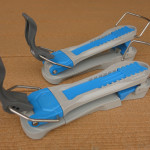
I’m wearing a Scarpa Alien boot on my right foot and a Montrail running shoe on my left, and without looking, it’s hard to tell the difference.  The Alien is the latest full-on race boot from Scarpa and one of the things I love about it is that it is so completely, apologetically specialized that it is hard to compare to anything else out there, including running shoes. For many years, the Scarpa F1 boot dominated the world of Ski Mountaineering racing to the point that the starting lineup at a race was referred to as “The Green Line” due to F1′s being green and everywhere you looked.  At the time, the F1 was also a state of the art race boot, but as racers started to tweak the living hell out of their boots by slicing, drilling, milling and grinding them, new rules were put in place to ensure that boots were hitting a minimal level of safety by having a certain amount of tread on the bottom and would work with crampons.  New boot makers started to get into the market and although the F1 was still popular, it took extensive home modifications to make it competitive. Continue reading ‘Scarpa Aliens’

Glacier Rope Set-up

Because ski mountaineering is so varied, there is no one single “best rope” out there that covers all the bases.  Sometimes you want a short, light, skinny rope just in case, and other times you need a full length, beefy multi-fall lead line.  In the past I’ve carried a variety of 60m ropes  based on what I thought the worst case scenario might be.  If there was a chance of having to lead vertical water ice, I’d bring a 9.8mm lead line.  If it was mainly a glacier trip, I’d bring a skinny 7.8mm rope.  There were two problems with this set-up; the first was that if you misjudged the terrain, you were lead climbing on a skinny rope (yikes!) or dragging a huge rope on mellow terrain.  The second was that you were always coiling/uncoiling and carrying generally more rope than you needed.  30m ropes are great for ski mountaineering, except when you need 50m.

On our recent trip to Antarctica I ended up bringing two 30m ropes of different diameters and was very psyched on the flexibility of the system.  Glacier travel with 4-5 people on a 30m rope makes for some tight spacing, but then again, it depends on the terrain. Antarctica had lots of crevasses, but they weren’t the Mack Truck swallowing monsters that you can get up in Alaska, so the tighter spacing meant better communications and less rope work.  We used the Sterling 9.2mm Fusion Nano most of the time and swapped out carrying the lighter 7.8mm Sterling Fusion Photon as needed. Continue reading ‘Glacier Rope Set-up’

3D Topo Maps

The first (and most likely only) time I went on a CMH trip, it gushed rain for the entire week. This was a tragedy and the lodge staff said that they had never seen anything like it in their entire history.  One of the saving graces was that I got to spend a lot of time marveling over the 3-D model of the surrounding terrain which was encased in a Stickley style floor table.  It was an beautiful work of art, and when I got home and dried out, I checked into making a similar version for the Wasatch.  The model alone was going to be many thousands of dollars, which put a crimp in the project, but not my desire.

This is perhaps a blessing as I recently had an opportunity to check out the 3D Atlas and posters from 2i3D, which provide a similar viewing experience for much less cost.  When viewed on a table, the images literally pop off the page in such clear, crisp resolution that it seems like you could slice your hand through them. This seems especially unbelievable as without the supplied 3D glasses, the images look fuzzy and muddled to the point that it almost hurts to look at them. Continue reading ’3D Topo Maps’

“Breaking Trail” review

I walked out of Brewvies theater last night after watching  “Breaking Trail”  expecting snow on the ground and found dry, hot asphalt instead.  Arrrg – pace thyself.  As penance, I swore it was going to be a crappy season with no skiing until early January. Continue reading ‘“Breaking Trail” review’

Rush v. Maestrale

The people of the backcountry will now hear the case of Rush v. Maestrale.  Please be seated.

I don’t think I toured a single day last year in anything but Scarpa Maestrale boots.  For resorts, I have a pair of Scarpa Mobe boots, but I have yet to brave any touring with them.  I come from a long line of Scarpa boots dating all the way back to the leather Tele Savauge (yes, tele…) and have been very happy with the Lazer/Matrix/Spirit line of three buckle boots.  My first impression of the Maestrale was dismay as it was a four buckle boot – gasp – but it turned out to be lighter and toured better than the Spirit 3 it replaced, so I never looked back.  But still, I secretly yearned for a three buckle boot as I seldom if ever adjust the toe buckle on a 4 buckle boot, so it is kind of vestigial and needs to be dropped. Continue reading ‘Rush v. Maestrale’

2012 Clothing Set Up

I’m the type of skier who likes to find gear that works and stick with it, and would rather spend my time skiing than dickin’ around with unfamiliar products.  My annual gear choices are made even easier as I have the great privilege and honor of being an “independent contractor” for a variety of companies, including Mountain Hardwear, so every year I just find the most expensive items and order two of every color.  ;)  Okay, not really. Continue reading ’2012 Clothing Set Up’

ABS Powder 15 Airbag Review

The ABS Avalanche Airbag System company has been around the longest of the airbag manufacturers and it shows in the construction and details of their ABS Powder 15. While the basic concept is the same as other airbags, the Powder 15 has quite a few unique features that make it ideal for a small airbag touring pack.  For a real-life video of an ABS Dual System bag being deployed in the French backcountry, click here.

Overview
A very well made and designed pack that features excellent detailing without going over-board on marketing features.  It is comfortable, carries well and has enough capacity to use as a day touring pack or for mechanized skiing.  The ability to swap out different “packs” onto a single base unit is nice.  The Powder 15 is lightest of the three packs I tested and its trim size makes you forget you are even carrying an airbag pack.  On the downside, it is the most expensive of the three packs I tested. Continue reading ‘ABS Powder 15 Airbag Review’