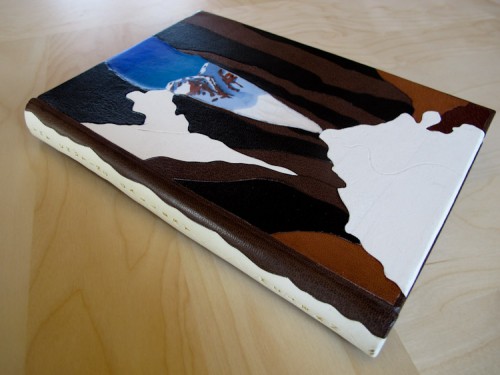
Just as I was thinking of putting The Chuting Gallery out as an eBook, I received a fantastic gift from Andrew Thompson that put the eBook concept into perspective. Andrew is an artist, illustrator and bookbinder from Brooklyn, NY who comes out to the Wasatch Mountains to go skiing. We had emailed me in the past about getting galley proofs of The Chuting Gallery for a bookbinding project, but I didn’t have any at the time, so I put the project on hold. Then, a few days ago, a package showed up from Andrew with an unbelievably beautiful, hand tooled leather book case, custom made with Chuting Gallery imagery and a Whippet graphic on the back. Continue reading ‘Chuting Gallery Ultimate Upgrade’
Monthly Archive for December, 2011
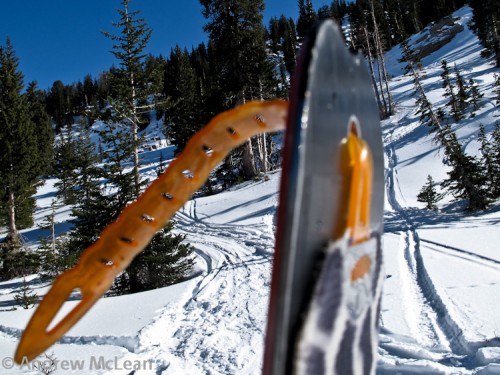
Traditionally, the main distinctions between alpine skis and backcountry skis have been that backcountry skis were lighter, may have have been reinforced for tele binding mounting and had holes in the tips & tails. The first two distinctions don’t seem to be as common nowadays, but the third, holes in the tips/tails, is still a desirable trait for a backcountry ski. This often brings up the immediate question “So, what are the holes used for?” The main reason for tip/tail holes is that it allows you to build a sturdy rescue sled, but the holes can also be used for rigging up your ski as a tent pole or setting up a self-cleaning belay anchor. Some people prefer to drag their skis by the tip holes instead of carrying them on their packs when booting. I’m not a big fan of this technique, but clipping your tips to your waist belt when bushwhacking works really well.
Last Tuesday I was out skiing (translation: hitting rocks and wallowing in 20″ of sugar) and found a new use for tail holes. One of our group lost a BD tail clip off of his skins, but by cramming the polymer strap through the tail hole, it hardly mattered. The ribbing kept the skin nice and tight, and aside from the hassle of threading and stripping it, it worked as well as a tail clip. Continue reading ‘New Use for the Old Hole’
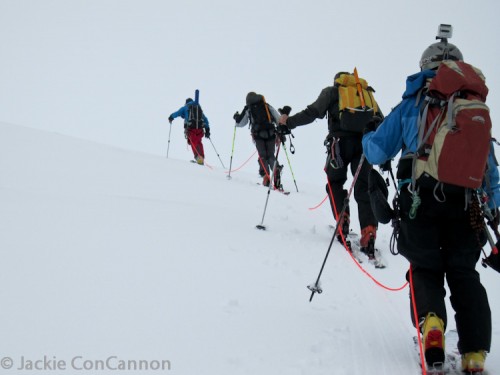
Because ski mountaineering is so varied, there is no one single “best rope” out there that covers all the bases. Sometimes you want a short, light, skinny rope just in case, and other times you need a full length, beefy multi-fall lead line. In the past I’ve carried a variety of 60m ropes based on what I thought the worst case scenario might be. If there was a chance of having to lead vertical water ice, I’d bring a 9.8mm lead line. If it was mainly a glacier trip, I’d bring a skinny 7.8mm rope. There were two problems with this set-up; the first was that if you misjudged the terrain, you were lead climbing on a skinny rope (yikes!) or dragging a huge rope on mellow terrain. The second was that you were always coiling/uncoiling and carrying generally more rope than you needed. 30m ropes are great for ski mountaineering, except when you need 50m.
On our recent trip to Antarctica I ended up bringing two 30m ropes of different diameters and was very psyched on the flexibility of the system. Glacier travel with 4-5 people on a 30m rope makes for some tight spacing, but then again, it depends on the terrain. Antarctica had lots of crevasses, but they weren’t the Mack Truck swallowing monsters that you can get up in Alaska, so the tighter spacing meant better communications and less rope work. We used the Sterling 9.2mm Fusion Nano most of the time and swapped out carrying the lighter 7.8mm Sterling Fusion Photon as needed. Continue reading ‘Glacier Rope Set-up’
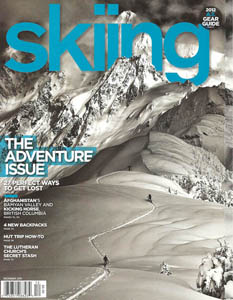
I was perusing the magazine stand the other day and ended up buying not only one, but two skiing magazines, which doubles my combined retail purchase of ski mags for the last two years. The first one was the 2012 Skiing Adventure Issue which I bought mainly for the Grant Gunderson double fold-out cover photo. It captures everything that is great about skiing in general and backcountry skiing in particular. The magazine also has a nice profile on Bill Briggs, some good trip reports and a concise backcountry gear guide. Continue reading ‘Ski Magazines Worth Buying’
It seemed hard to believe that anything could ever top the 2009 Ice Axe Antarctica Ski Cruise, but I think this year actually did. In 2009 we had freakishly good weather (clear, sunny and calm every single day), but in 2011, I think we were able to get into more interesting terrain. Part of this had to do with the ice pack conditions, but another part was Doug Stoup and company knowing where to go and when. As with both trips, the people and the energy of having 120 like-minded skiers on board a boat cruising around at the bottom of the earth is really what makes it all worthwhile. You go for the skiing, but in the end it’s the entire package that you remember.
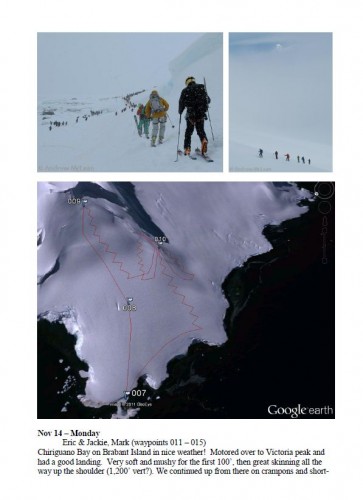
We had six days of skiing in Antarctica with 2-3 in Ushuaia, Argentina beforehand. I kept a photo, gps and written log of where we went, which is available by clicking the photo below (2mb pdf file). Continue reading ‘Antarctica 2011 – Trip Report’