Monthly Archive for March, 2009
Heliskiing Everest and Friends of Flagstaff

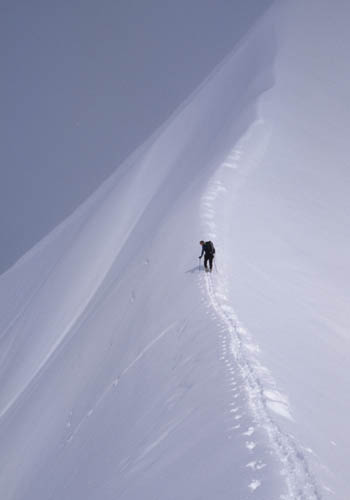
Access to backcountry skiing seems to have been an issue for at least as long as the sport has been around, but for me, the entire discussion changed on May 14, 2005 when a helicopter landed on top of Mt. Everest.  Now the discussion is no longer if you could take a machine to anywhere on earth, but if you should.  Is heliskiing Everest elitist, or does it mean that it is now available for anyone, not just the elitist who feel that you have to walk up there?

If you have never seen this, it is some amazing footage.

As far as I know, heliskiing on Everest is not currently being considered, but on a local Wasatch note, a chairlift up Flagstaff Mountain is and it would have a huge impact on the backcountry skiing here.  The Friends of Flagstaff have organized a meeting at the Salt Lake City REI tonight (Tuesday at 6:30 – free), and I’m giving a short presentation as part of an informative panel discussion with many of the people involved.  If you have a chance, please come by.

________________________________
Help support StraightChuter.com and keep your moral bearings with a Suunto MCA-D Challenger Compass from Backcountry.com. Click on the photo below…
 

BackCountry Magazine Ski Test

Although I suspect my invitation to the annual Backcountry Magazine ski test extravaganza was a clerical error, I took them up on it anyway as it was a good excuse to drink Adam “Howie” Howard’s beer and ski at Powder Mountain.  I’ve been involved with many ski tests over the years, but lately have been developing an inferiority complex about them as I tend to like skis that everyone else hates.  It’s kind of like being picked last for High School basketball, which I also eventually got over.
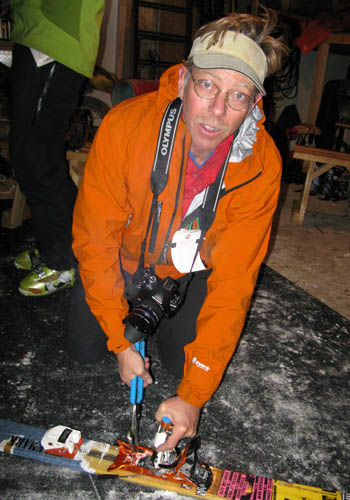
Craig Dostie element as he engages in his Life Calling of doinking with telebindings to work.  This pair just needed a little extra loving from the #10 Channel Lock pliers.

Craig Dostie in his element as he heeds his Life Calling of doinking with telebindings. This pair just needed a little extra loving from the #10 Channel Lock pliers.

Pow Mow is a totally rocking little area.  If it was 10-degrees steeper overall it would be unbeatable.

Pow Mow is a totally rocking little area. If it was 10-degrees steeper overall it would be unbeatable.

This year was no different. We missed the first two days, which were epic powder snorkle fests and, predictably, the phatties ruled the roost.  As we were unloading a portion of the 200+ pairs of skis that were available, I was first amazed at how big, phat and heavy they all were, then dismayed to hear that these were actually the skinny schwagg that needed to be tested and the true fatties were under lock & key as they were all anyone wanted to ski on, but had been already thoroughly tested.  (After taskmaster Drew Pogge left on the third day, the fatties leaked back out.)

The 2009-10 version of skinny little wimpy skis.  The big bouys were under lock & key.

The 2009-10 version of skinny little wimpy skis. The big bouys were under lock & key.

Of all the ski tests I’ve been to, this one was by far and away the most fun as they allowed plenty of time for it (4-5 days), invited a cross-section of 40 plus people and held it at a resort which was very testing friendly with easy access and good terrain.  The knee-deep dump of Utah pow didn’t hurt either.

Jon Howard (left) and Adam Howard (right), who are unrelated, but partners (in a business sense) in Backcountry Magazine, which is based in Vermont.

Jon Howard (left) and Adam Howard (right), who are unrelated, but partners (in a business sense) in Backcountry Magazine, which is based in Vermont.

Craig Dostie holding up a bit of history - an early copy of "Le Chronical du Couloir" which later turned into Couloir Magazine, which was eventually bought by Backcountry Magazine, who was hosting dinner and the ski test.  Craig has copies of all except the first three issues of the Chronicle, and when I asked him if he thought there might be some hidden away somewhere in the world, he said "I doubt it.  I mean, I was the publisher and I didn't bother to keep any!"  He produced a great magazine which inspired many people (including myself) and left an amazing legacy.

Craig Dostie holding up a bit of history - an early copy of "Le Chronicle du Couloir" which was the forerunner to Couloir Magazine. Craig has all except the first three issues, and when I pondered whether anyone, anywhere might have them, he said "I doubt it. I was the publisher and even I didn't bother to keep them!" Craig put out an excellent magazine which inspired many people (including myself) and left an amazing legacy.

I made a point of skiing the phattest fatties I could get my boots into as well as reverse camber, elongated noses, pin tails, no sidecut, ultra long (195cm), boutique skis and mainstay manufacturers.  I stayed away from skis and brands I was familiar with as I ski those all the time. I thought I was doing pretty well to get 4-6 pairs in per day until I met Jamie, who was on her seventh pair by lunch-time and had racked up over 31 pairs in the last few days.  I don’t know what she ultimately liked best, but was impressed with her and many other people’s diligence.  Between this sort of enthusiasm and the volume of people, the published results should be very comprehensive.

Jamie pausing for 23 seconds to eat lunch before hopping on another pair of skis.  Between the two of us, we tested over 50 pairs of skis.  I did seven, and, uhmmm, she did the rest.

Jamie pausing for 23 seconds to eat lunch before hopping on another pair of skis. Between the two of us, we tested over 50 pairs of skis. I did seven, and, uhmmm, she did the rest.

________________________________
Help support StraightChuter.com and get some crowd pleasing Black Diamond Megawatt Skis on sale now at Backcountry.com. Click on the photo below…

Steep Skinning – Mindset

Having the right mindset is almost as important as the right gear and technique when it comes to steep skinning.  You have to be into it.  I was out touring with a friend from Switzerland in the Wasatch Mountains a few years ago and he refused to follow any of the existing skin tracks, which tend to be steep (from what I’ve heard from out-of-state visitors – they seem normal to me).  “These skin tracks are stupid!”  We ended up breaking new trails, which is about the worst that can happen if you can’t or don’t want to push the angle.  So what, eh?

Another little trick is to be calm a subtle with your footwork and try to milk every little irregularity you can.  Put your ski/skin down once, pressure it firmly and stand up on it smoothly.  Stomping rarely helps and more often than not destroys any grip the snow might have.


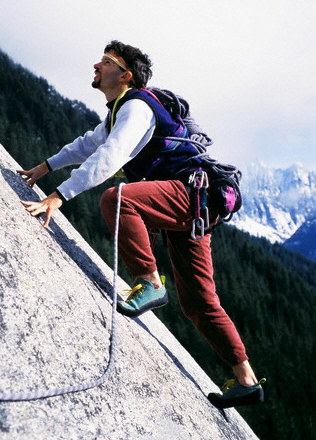
Perhaps one of the reasons I like steep skinning is that I also like friction climbing (moderate angle, smooth slabs, minimal handholds).  I was a little insulted when a friend once said “Oh yeah, friction climbing – whatever.  Once you get the hang of that you can hike routes all day long.” which is kind of true.  More than anything it is about developing a feel for the rock or snow, trusting your feet and relaxing.  Once you get comfortable with these elements, you can hike steep skin tracks all day long.

________________________________
Help support StraightChuter.com and get your groove on with Black Diamond Ascension Nylon STS Skins on sale now at Backcountry.com. Click on the photo below…

Steep Skinning – Technique

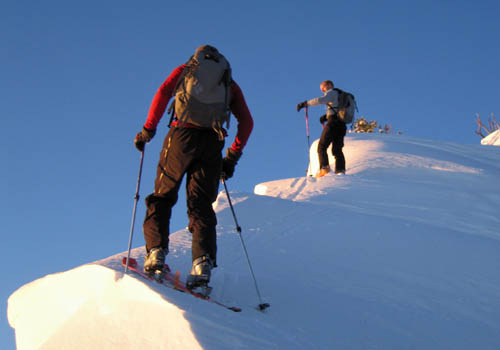
The technique for steep skinning is just the opposite of skiing, which makes sense as you are going up, not down. One of the harder things to get the hang of is the idea of leaning back, not forward.  Because touring bindings have a pivoting toe, it is hard, if not impossible to pressure the tip of the ski while in tour mode, which means you can’t press the skin’s nap into the snow.  Because of this, all of your grip comes from your toepieces back, so you want to make sure that is where your weight is. 

Chris Figenshau skinning up a 34-degree icy slope in New Zealand with textbook perfect style. Not bad for a photo dude from J-Hole. Good job Figs.

  1. Keep your back straight – don’t bend/break at the waist
  2. Keep your skis as flat as possible on the snow to maximize the surface area
  3. Press through your heels (important)
  4. Plant your poles near to your toepieces – not too far forward or off to the side.
  5. Stay off of your edges.  If you need to move sideways, “crab” to the left or right by moving your entire ski instead of trying to edge.
  6. Look up and forward, not down at your boots.  As the Bloodhound Gang song goes – “Lift your head up high and blow your brains out.”  Steep skinning may be painful until you get the hang of it, but it also gets you places in a hurry.

If you find yourself slipping, try lifting your big toe.  This is hard to do if you are leaning forward, (so lean back) and it will help shift your weight to the aft.  It’s like hitting the brakes.
________________________________
Help support StraightChuter.com and crank on up with Dynafit TLT Vertical ST Bindings from Backcountry.com. Click on the photo below…

Steep Skinning – Gear Adjustment

You don’t need any special gear to lay down a steep skin track, but there are a few adjustments you can make to your existing set-up which will help.

Heel lifters are absolutely essential and should be turned to their highest setting.  Don’t be bashful. Certified guides dislike heel lifters for their clients as they are too tippy, but once you get the feel of them, there is no going back.  It’s kind of like walking around on a roof with high-heels – it may not seem like a good idea, but it keeps your foot flat so you can use your thigh muscles instead of your calves.

Lifters up, poles down, feet flat. Go dog go.

Shorten your poles down so you can get on top of them instead of hanging off of them.  Pushing on them instead of pulling allows you to use your arms, chest and back instead of just your arms.  It is the difference between doing push-ups and pull-ups.  I can do little cheater push-ups all day long but am cooked after about ten pull-ups. If you have asymmetrical baskets (and you should), rotate them with the short side forward so they don’t lever out.

Get some good nylon skins.  Nylons are known for their sticky climbing abilities and that’s what we are talkin’ about here. Good glue and a tip & tail kit are also important for steep skinning as you put a lot more sheering force on your skins than when you are just scooting along on the flats.

LG working it out in Alaska.

LG setting a 40 degree track in AK.

Undo your top boot buckles so you have maximum ankle flex.  I usually keep my forefoot buckle fairly tight (as tight as I’d have it for skiing), the ankle buckle semi tight and totally undo the top buckle.  I don’t use the Velcro powerstrap, but if I did, I’d loosen that all the way as well.  Of course, make sure your boots are in tour, not ski, mode. Like friction climbing, steep skinning requires a subtle feel and you want control without restriction from your boots.
________________________________
Help support StraightChuter.com and get on top of a Black Diamond Whippet Self Arrest Pole on sale now at Backcountry.com. Click on the photo below…

Steep Skinning – Part 1

Spring is here and the time is right for skinning in your top pegs.  I don’t go out of my way to always pick the steepest skin line possible, but there are times, actually, a lot of times, where a steep skin track angle is much safer, faster and more efficient.

Few things in backcountry skiing piss people off more than a steep skin track, but that is probably because they don’t know how to ascend it properly. Once you get the hang of it (details to follow in this week’s postings), setting a steep track can be way faster than wandering all over the hillside at the prescribed 12-degree perfect angle.

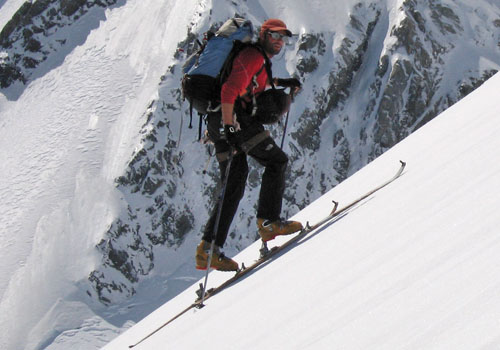
Lorne Glick busting out a steep one on Thunder Mountain, Alaska. This direct line hit 40 degrees in places and kept us out of avalanche starting zones.

A few steep skinning myths:

A lower angle skin track is more efficient.  
Not so.  Walking up a low angle handicap access ramp is technically easier step-by-step, but no more efficient than going straight up a flight of stairs.  It takes a set amount of energy to climb a mountain and the variables are time and distance traveled. 

The fastest racers in world all use lower angle skin tracks.
True, but that has as much to do with using bindings which only have one elevation setting and skins which glide better than they climb.  The top guys/girls are also plenty speedy on steep tracks as well.

Steep tracks are set my macho jerks with something to prove.
Perhaps.  Then again, maybe they are setting a steep track as an ability barrier to keep a powder stash from being overrun once the track is in.  If people can’t get up, they can’t ski down.  See the “no friends on a powder day” rule for further clarification.

________________________________
Help support StraightChuter.com and bust out a steep one with Black Diamond GlideLite Nylon STS Skins on sale now at Backcountry.com. Click on the photo below…
 

Indian Creek – Photo TR

Continuing an almost full week of trip reports, I went down to Indian Creek on Wednesday with my long time skiing and climbing buddy, Brad Barlage.  Brad is a sales rep for Black Diamond, which means he has the full-on pimp daddy ride (Ford Van), tons of gear, plenty of dogs and knows The Creek inside and out.  If he ever disappears from society, this would be the first place I’d think of to start looking for him.

Even though they have almost nothing physically in common, once you get the hang of hand/finger jamming, the sensation of climbing a perfect splitter crack is akin to center-punching a virgin field of thigh-deep powder.  Neither one is truly effortless, or always safe, but the purity of the line and movement over beautiful terrain brings the same type of smile to your face.

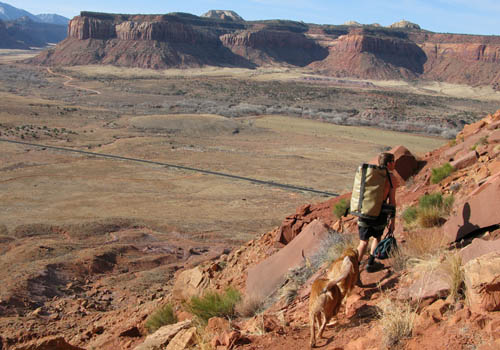
A dog, a crack and some gear on your back. B-Rad doing the brutal ten-minute approach to one of many walls.

Spring Loaded Camming Devices (SLCD's) made climbing parallel sided cracks like this one much safer, and thus more popular.

FEEL THE POWER! The more cams you own, the more cracks you can climb. Arnie (the Golden Retriever) is actually a fierce guard dog.

Starting up Double Trouble. The clock is ticking...

About halfway up Double Trouble. B-Rad doing a fine job leading.

Pumped to the gills - just what we came for.

With literally 1,000's of cracks to choose from, it is easy to get confused. Fortunately, some of them have "tiles" like this at their base.

Super Crack, aka Super Crack in the Desert, aka Luxury Liner. The first ascent of this crack opened peoples eyes to the possibility of safely climbing smooth, parallel sided cracks and marked the beginning of the sandstone crack climbing boom which continues to this day.

The Incredible Hand Crack. The bulk of this climb is "perfect hands" which is why it is so popular. The white marks on either side of the crack are from climbing traffic.

________________________________
Help support StraightChuter.com and fear no crack with a Black Diamond Camalot from Backcountry.com. Click on the photo below…


Speedy Bowline Tie-in Trick

I took a skiing time-out yesterday to go crack climbing at Indian Creek, Utah with Brad Barlage. While we were roping up, Brad showed me this cool little trick for tying a Bowline knot around your harness. 

Bowlines are the King-of-Knots as they strong, simple and easy to untie after they have been loaded.  Because of this, they are the knot of choice for sailing, but for climbing the “easy to untie” part can be problematic if it happens when you don’t want it to.  For this reason, many climbers back them up with a securing overhand knot. 

Bowline connoisseurs might notice that in this demo the tail is outside the legs, instead of inside.  This can be fixed by feeding the tail through the hole in the other direction.

________________________________
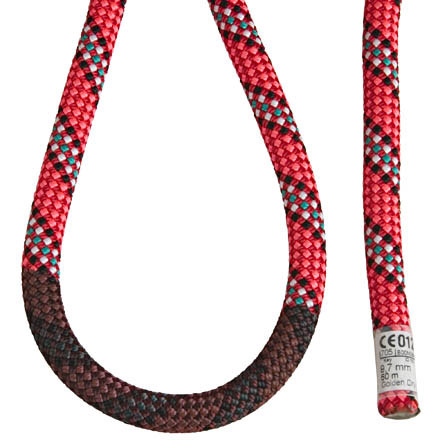
Help support StraightChuter.com and tie in with a Beal Booster III 9.7mm Climbing Rope on sale now at Backcountry.com. Click on the photo below…
 

TR – Shooting Star Saloon, Huntsville, Utah

My mother’s side of the family immigrated to Utah five generations ago, but not for the usual reasons.  Instead, they were here to start a brewery – Fisher Beer.  The brewery has been gone for close to 50 years, but beer in Utah remains a topic which is close to my heart, or liver in this case.  Because of this, I was interested in visiting the historic Shooting Star Saloon in Huntsville last weekend when I was up at Powder Mountain for the kiting festival.

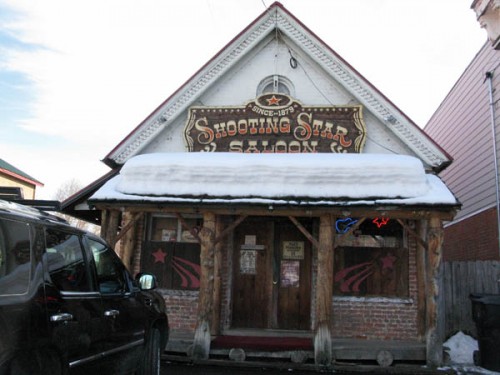
The little saloon that could. Operating in Utah for 130 years.

Starting business in 1879, the Shooting Star is the oldest surviving saloon in Utah, which makes it a glowing beacon of hope in a state known for its obtuse liquor laws.  What makes the Shooting Star even more unique is that it is located deep within rural Utah and not in the sinners haven of Salt Lake City, or worse yet, Park City.

Part of the saloon’s longevity probably comes from it being built out of brick, but on the business end, it serves a mean $3.00 burger, draft beer for $1.25 and is packed with personality.

Welcome to Utah.  Any questions?

Welcome to Utah. Any questions?

There must be over $1,000 worth of dollar bills stapled to the ceiling. I'm sure there's a history to this, but it also just seems to fit right in with the decor.

A rotating illustration behind the bar which depicts the phenomena known as "beer goggles."

The wall of wisdom.

The measure of any self-respecting bar is what kind of dead animals they have on their wall, and in that regard, the Shooting Star is off the charts.

From the men's room - it's almost like not being in Utah.

________________________________
Help support StraightChuter.com and tip back an unbreakable GSI Outdoor Beer Pilsner Glass on sale now at Backcountry.com. Click on the photo below…
 

Superfly Open – Kiting Festival

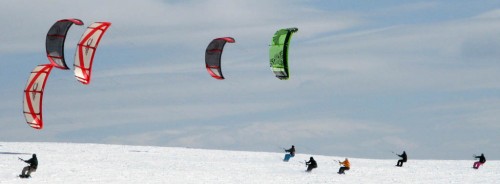
The second annual Super Fly Open kiting festival was held this last weekend at Powder Mountain, Utah.  Affectionately known as Pow Mow, the Eden based ski resort has an exposed ridgeline perched right at its summit which makes for perfect kiting conditions.  There aren’t many obstacles to collide with and the wind can be moderated by going higher (stronger) or lower on the hillside.

The last leg of the fast & furious snowboard kiter-cross event.

The festival is a loose affair with a variety of freeriding, kiter-cross, cross-country, big air and rail riding competitions, as well as parties, a Best Girls talent search and  evening presentations.

Floating effortlessly over the Odgen valley.

As a self-taught kiter, I like going to festivals like this as I always learn a lot.  While I have no problem catching air, my landing sucess ratio is about 10%, so I tend to keep my skis on the snow as much as possible.  Over the weekend I heard this referred to as “mowing the lawn” (going back and forth over and over) which seems humourously appropriate.

Jacob Buzianis, the man behind (literally in this photo) Best Kites in Utah. After setting up the demo kites, helping people get started and giving tips, he goes out and places in the top three of any of the events he enters, which is the sure sign of being a Super Ambassador for the sport. Nice job Jacob.

As one of the main sponsors, Best Kites had a quiver of demo kits available.  The technology on these beasties is impressive and in the right hands there is no limit to where riders can go – upwind, downwind or extended flights.

Since riders discovered the kiting potential at Pow Mow a few years ago, the resort has fully embraced the idea by dedicating a chunk of their property exclusively to kiting and offering lessons and rentals through the Best Snowkite Center.  Maybe they can teach me how to actually land standing up instead of on my head…

Closing in on the first mark of the men's kiter-cross snowboard division.

________________________________
Help support StraightChuter.com and fly high with a Best Kiteboarding Yarga Kite on sale now for as little as $400 at Backcountry.com. Click on the photo below…