Monthly Archive for February, 2009
Gear – A Question of Balance, Part II

In regards to balanced gear diets, here are my current favorites:

Superlight  (15% of the time)

   Skis – 160cm K2 Sahale (68mm waist)
   Bindings – Dynafit TLT’s without brakes
   Boots – Scarpa F1

Comments:  In the right conditions, I love this set-up as it tours effortlessly.  Because it is so light, you don’t have to be going very fast to feel like you’re haulin’ ass, so the thrill is the same as mach-schnelling downhill with a much heavier set-up.  The disadvantage is that it gets knocked around in anything less than ideal (corn/powder) conditions.

Medium Light (45% of the time)

   Skis – 167cm K2 Backouts (Euro skis similar to Chugoris/Summits – 72mm waist)
   Bindings – Dynafit ST Verticals with brakes
   Boots – Scarpa F3

Comments: I prefer this set-up whenever possible as I can ski powder, chutes, meadow skipping, etc. and it has it covered.  It tours very well but is a challenge when the snow gets tricky.  For expeditions, I take this set-up with the Scarpa Spirit 3 boots as the F3′s can get overpowered with a heavy pack or wind-jacked snow.

Medium Heavy (35% of the time)

   Skis – 167cm K2 Mt Baker Superlights (88mm waist)
   Bindings – Dynafit Comforts (no brakes)
   Boots – Scarpa Spirit 3

Comments: I use this set-up for powder, shorter tours or when I’m going out with a semi heavy-metal crowd.   I love the way it skis (especially powder), but there’s a weight penalty for longer tours. 

Heavy Metal Thunder (5% of the time)

   Skis – 167cm K2 Kung Fujas (twin tip alpine skis – 94mm waist)
   Bindings – Marker Dukes
   Boots – Scarpa Typhoons

Comments:  I use this set-up for kiting as I get yanked around and land backwards (twin-tips help), as well as resort skiing.  I like the Marker Dukes for this as they have excellent return-to-center abilities, a clean, predictable release and are brainless to step into.  Weight isn’t an issue as I’m probably not carrying them more than 100′.  Tourability is almost more of an insurance policy – it would be better than post holing.

An embarrasment of riches?  Yes, but it is a job and somebody has to do it.  :)

________________________________
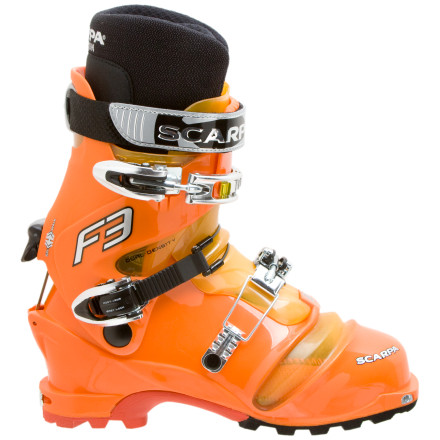
Help support StraightChuter.com and cover some ground with a pair of Scarpa F3 Alpine Touring Boots on sale now at Backcountry.com. Click on the photo below…
 

Gear – A Question of Balance

Individually, skis, boots and bindings are important, but a far more significant concept is how they all work together.  I was reminded of this the other day when a friend mentioned that he didn’t think his new boots were stiff enough, which may have been the case, but then again, the 125mm waisted skis he was on may have just been too much for them as well.

Light is right... for long and/or fast outings.

Even if you buy all top-of-the-line gear, it can still seem “off” if it isn’t matched carefully.  A quiver of skis is nice, but a quiver of skis/boots/bindings is even better.  For backcountry skiing, I alternate between three set-up; superlight racing, lightweight all-purpose and the heavy-metal monsters.  I’d be hard pressed to pick a favorite as they all serve such differnt purposes, and in their respective catagories, I think they all ski really well.  On rare occassions I’ll use a heavier boot on a lighter ski, which can be fun as you can drive the ski like a nail and make it come around REALLY fast.

Mid weight, all around. Hard to go wrong, except if you are going really far, or really fast.

When I look at a new skis, boots or bindings, the catagory they are in (light, medium, heavy) is more important than the individual product.  For example, Dynafit TLT bindings (light), Scarpa Spirit 3 boots (medium), and K2 Coomba skis (heavy) are all great products, but would be a horrendous combination.  Conversely, when properly matched, the sum of an assembly of mediocre gear can be magical.

Heavy metal thunder (although not really a touring set-up).

 That said, if it skis good, it is good.  Your mileage may vary.

________________________________
Help support StraightChuter.com and go big with a pair of Scarpa Typhoon Alpine Touring Boots on sale now at Backcountry.com. Click on the photo below…

The Unwritten Rules of Dawn Patrolling…

… must now be written.

Waking up at 4:30am to go skiing on a work day never gets any easier, but is always rewarding.  One of the first times I ever did it I remember being terrified that I’d get to work late and be fired on the spot, but 200+ Dawn Patrols (DP’s) later that still hasn’t happened and most likely never will.  The hardest part about DP’ing is just dragging your ass out of bed and from there, with the exception of the skinning part, it is all downhill.

Whoa... it's like a weird bad dream, except we're going skiing.

Rule #1 – Get up IMMEDIATELY when the alarm goes off.  No snoozing allowed.  You shan’t recover from the evil Dream Bar that early in the morning.

Rule #2 – Have all of your stuff packed and ready the night before.  You can’t think straight at 4:30am.  Pack everything up, put it in the car, attach your skins to your skis, girth hitch your headlamp onto your pack (quick & easy access in the dark), preadjust your poles for skinning, etc..  You should be able to start skinning within five minutes of turning the car off at the trailhead.

Skisbootspoleshatglovesgooglesheadlamp. Check.

Rule #3 – Don’t be late.  Making people wait for you at 5:30am pushes the limits of friendship, plus, if someone is going to oversleep at that hour, it will be by a lot, not just a few minutes.  One of my favorite No-Wait-State stories went like this;

“Well, Dave isn’t here. Should we wait for him?”
“What time is it?”
“5:01″
“I think we just did.”

Rule #4 – If you bring a friend, you are responsible for him/her.  It is just the way it goes.

"I light the fire while the city sleeps." MC 900' Jesus

Rule #5 – Being self sufficient is essential.  Wandering around in avalanche-prone mountains while being under a time constraint and exercising hard in the pitch black requires a large amount of personal assumption of risk, to say the least.  Your partners can only help you so much.

Rule #6 – Pick a safe objective where you stand a good chance of not getting lost, whacked by an avalanche, having your car towed or falling to your death in the dark.  There’s a good reason why certain runs are considered classic DP outings.

The pay-off. The hardest part of DP'ing is standing up in the dark when you alarm goes off.

Rule #7 – Forgetting your headlamp, skins or boot liners qualifies as Grounds for Rounds at a local bar at some future date.

________________________________
Help support StraightChuter.com and light up the night with a Black Diamond Cosmo Headlamp on sale now at Backcountry.com. Click on the photo below…
 

Hans Saari Ski Exploration Grant – Deadline 03/01

Skiing expeditions have been described as many things, but “cheap” is not usually one of them.  A three weeker to Alaska is about $2k per person.  Baffin Island might come in at around $3,500.  Patagonia might run about $3k, the Himalayas are 6-8k depending on the peak and the granddaddy or them all, Antarctica, could easily set you back anywhere from 8 to 25,000 smackers.  What’s a poor dirt-bag ski mountaineer to do? 

Aside from the obvious (get a job), the next best thing is to go on cheap trips and apply for grants.  There are a variety of grants out there ranging from the platinum plated Rolex Award all the way down to the time honored technique of borrowing $100 from your parents and hoping they don’t ask you to pay it back.  From a ski mountaineering perspective, one of the best grants ever offered is the Hans Saari Ski Exploration Grant, which is now in its second year.  One of the coolest things about this grant is that it is 100% specific to ski mountaineering, so you won’t be competing against a team of white-water vegans who are attempting the first descent of the Zampoli River to raise awareness of global warming (a sure winner).

hans whitetail

Hans topping out on Whitetail Peak in the shadow of Alex Lowe and myself. This was the first day I'd ever met Hans.

The Exploration Grant is part of the Hans Saari Memorial Fund which was formed by family and friends after Hans fell to his death in Chamonix in 2001.  The grant is a reflection of Hans himself in that it favors human powered ski mountaineering trips to explore new areas and adds in an element of creative documentation.  Hans often wrote articles about his adventures, but in terms of the grant, any sort of documentation will be considered, from writing to websites, slideshows, videos, photography, a painting or even interpretive dance if you are so inclined.  The idea is to go skiing somewhere cool and then share the experience with others as these guys/girls did last year.

shish ABC horz

Hans relaxing at Advanced Beach Camp, Tibet.

Explorer H.W. Tilman once said “Any worthwhile expedition can be planned on the back of an envelope.”   The application for the Hans Saari Ski Exploration Grant takes this one step further and doesn’t even require and envelope – you can apply for it entirely on-line after downloading the application here.

While on the topic of Hans, I’ve created a small photo gallery of some of my images of him in action.
________________________________
Help support StraightChuter.com and chill out Hans style with a North Face 2-Meter Dome Tent from Backcountry.com. Click on the photo below…

Ouray Ice Park

Aside from being cold, dangerous, expensive and limited to a few select areas in the world, there is a lot to be said for ice climbing.  Namely, it can be a ton of fun and there is nothing like sinking a pick & ‘poons into a vertical pillar of frozen water which may or may not collapse and kill you.  It’s fun for the whole family.

Where there's blood, there's ice climbing.

I mainly ice climb just to stay proficient at it so that if I ever come across a section of ice on a ski mountaineering trip, I’ll know what to do.  Modern ice tools and crampons have made vertical water-ice almost so trivial that nowadays the worlds toughest ice climbs take place mainly on rock.

Traditionally, ice climbing meant long approaches to a remote waterfall which the climber would then have to ascend from the bottom up, placing ice screws along the way for protection.  Ice screws are expensive and placing them is tiring, so the standard operating procedure was to run it out and hope for the best.  In the meantime, your partner who is belaying you at the base of the climb is getting brained with large chunks of ice falling from above while his hands go numb from cold.

Mountain Hardwear Athlete Dawn Glanc makes it look easy.

But… the Ouray Ice Park has changed all of that.  The park has been around for about 15 years and as America’s premier ice climbing center, it attracts thousands of visitors from all around the world each year. Ouray, Colorado has always been a hotbed of ice climbing as it was central to classics like Birdbrain Boulevard, The Ames Ice Hose, Bridelveil Falls (in nearby Telluride) and The Whorehouse Hose in Silverton.  Whereas these are all big, natural ice flows, what makes the ice park unique is that it is almost entirely man-made.

One of many sections of the Ouray Ice Park. The competition routes climb up the ice, then traverse onto the overhanging board in the middle of the bridge.

The ice park began as almost a happy accident when an old water tube which ran along the top edge of the 100′ deep Box Canyon sprung a leak. This leak turned into a perfect ice pillar which was so easily accessible from town that it became a  destination climb in itself.  Soon after that, a group of enterprising climbers constructed a system of 20-30 shower sprinkler heads along the lip of Box Canyon and began “farming” ice by turning the water on at night and then climbing the pillars by day.  Currently, the canyon sports and endless array of climbs ranging from overhanging desperadoes to lower angle learning areas.

Mountain Hardwear designer Tracey Mammolito stickin' picks.

Approaching the ice from the town of Ouray involves a ten minute walk (you can also drive if you concerned about bulking your legs up), so you can sleep in a warm bed, have a civilized breakfast, go ice climbing, come back for lunch, do another session in the afternoon, then eat at a restaurant and swill American whisky at night.  Most of the climbs have permanent beef-cake anchors at the top, so you can rig a rope over a pillar, rap down, and then top rope it to your hearts content.  There is also an area dedicated to lead climbing if you want to break out your Christmas ice screws and scare yourself.

The walkway along the top of the ice climbs with anchors to the right and sprinkler heads to the left.

For technical and legal reasons, the ice park is free although any donations will be gratefully accepted.  It is a great way to check out ice climbing, especially as you can rent all the gear you need in town as well as hiring a guide to literally show you the ropes.  It’s fun.  Really.

________________________________
Help support StraightChuter.com and stick it good with Black Diamond Fusion Ice Tools on sale now at Backcountry.com. Click on the photo below…

Ouray – limited connection

I love Ouray, Colorado for its skiing, ice climbing and scenery, but the connection speed leaves something to be desired.  This is a blessing and curse, but for now, it means more climbling and less Internet.  So be it.  Details to follow.
MHW Tent Winner & Answers

Winning location:

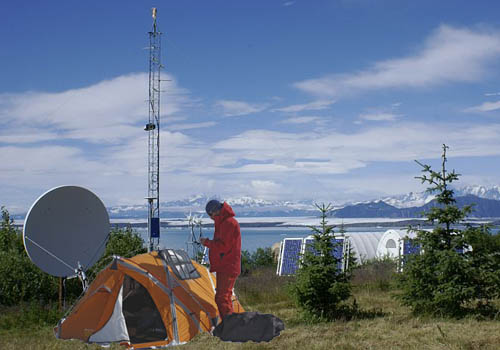
The Bering Glacier Scientific Camp on the southeast shore of Lake Vitus, Alaska.


"Glickster, get yer paws off of my tent." The Bering Glacier Camp with Vitus Lake in the background.

Ron Enns from Squamish, BC is the winner and nfrancois gets a runner-up prize!  Nice job guys! 

Ron is debating between a Spire 2.1 or an EV-2 tent.  Here’s how he found it:

I thought back to your New Zealand contest and tried to think of the type of question you might ask, which I thought might be a camping location somewhere on mountain itself, or a place from where expeditions to the mountain would originate. I did some searches on the internet over the last few days and tried to familiarize myself with the mountain and its named features (cols, glaciers, ridges, etc.) and the surrounding area. As soon as I read the Super Cluesday clue though, I knew I had to do some further quick internet searches. I kept checking the comments, thinking you might provide further clues (as you did do) and your additional clue about someone being able to see the location with binoculars from the location that he guessed helped me narrow down my internet searches. I made several guesses of cabins around the area in question, and fortunately one of them was right. 


You can get there from here. Click to enlarge and see details of the epic journey and wild terrain.

Lake Vitus details.


Details of the scientific camp can be found HERE.


Clue Answers:


#1 – Continent

In 1995 Troy Jungen (Beaver Indian) and Ptor Spricenienk skied the steep, exposed north face of Mt. Robson in the Canadian Rockies. They are both from Canada, which is part of the North American continent.


#2 – Country

Perhaps the ultimate bad-ass skier of all time, Steve McKinney (brother of Olympian Tamara McKinney) was the first person to break the 200 kh limit on skis.  Steve was from the Tahoe, California area, which is part of the country of America.  From left to right in the photo: Steve McKinney, Dick Dorworth, myself, Otis Kantz, Tim Tilton and Bill McKinley.  Photo by Craig Calonica?


#3 – Mountain Range or Zone

Known as “The Mountain Kingdom”, the Wrangell-St.Elias National Park and Preserve is the largest park in the US at over 13 million acres.  When combined with Canada’s Kluane National Park and Preserve next door, the total area exceeds 25 million square acres of the wildest terrain on the continent, if not the earth. The WSE Park contains the Wrangell, St. Elias, Chugach and Nutzotin/Mentasta mountain ranges.


#4 – Specific Peak

Mt. St. Elias is the second highest peak in America at 18,008’.  Due to its burly, remote location and no easy way down, it has attracted relatively few ski attempts over the years.  Of those who tried, Reid Sanders and Aaron Martin died while trying in 2002. In May of 2000 Lorne Glick, Andy Ward and James Bracken skied from the summit via the Mira Face and back to the Bagely Icefield.  In 2007, a Red Bull team with a reported budget of over 1 million Euros skied the lower section of the south side of St. Elias, then returned months later to ski the upper section, claiming it as the longest ski descent ever done.


#5 – Specific Location


Our epic journey begins at the top of the peak identified in clue #4… (Mt. St. Elias)


Gasp…gasp, shiver….shiver… let’s get going.  It is freezing cold, high and hard to breathe up here.  We’ve been climbing all night to get here and are now going to turn around and follow our boot tracks back down, repeating the line of the first descent (Lorne Glick 2000 descent).  Aside from being too numb to feel anything and bouncing over sustrugi so hard it chips our teeth out, the top part goes quickly and then leads to the business end of the descent – a beautiful, steep, open and exposed headwall.  There’s no time like now, so you start down its flanks which are covered with dragon-skin rippled powder over ice.  You’ve forgotten your camera, which is too bad as the face is so beautiful you could name a classic ski after it, or a small red-headed child. (The Mira Face.  Black Diamond named a ski after it (Mira) and our daughter is also named Mira.) 


Each turn brings you closer to terra firma, until at last you glide out on a vast open plane of dazzling white. (Bagley Icefield)  Thank god that’s over, but where do we go from here?  Looking left and right, you decide to follow the sun (setting sun = west) as it slowly sets and start walking.


And walking.  And walking.  At the stately pace of early Antarctic explorers, you cover 15km per day for five days and six hours in an almost straight line. (49 miles to the west along the Bagley) You wish you had brought your headphones and start to wonder if you are even still in the protected mountain zone you started in. (you eventually cross out of the WSE National Park & Preserve) Taking a breather you notice a natural arch (feature noted on map) and follow the flow of gravity around it.  (flow of gravity = turn south/left to the ocean)


The traveling surface is firmer now, but in a cruel twist of fate, it is also more broken up (Bering Glacier).  On the bright side, you are slowly trending downward and moving faster, but on dark side, you still have two full days of travel at twenty-five miles per day to get there, wherever there might be. (Travel another 50ish miles on the Bering Glacier)


Suddenly, the slope runs out and you can ski no more.  You are confronted with a body of water so vividly colored that you pray that it was given the first name of the explorer who first discovered it. (Lake Vitus, named after Vitus Bering) Wondering which way to go now, you hear the sound of large mammals (Bay of Whales) and begin contouring around the water in that direction.  Seeing nothing, you continue around a sharp point (Arrowhead Point), when suddenly it occurs to you… today is April 15th.  Taxes are due and you haven’t paid yours. (you are now at Taxpayers Bay) Fearing your great adventure is now going to end up in a lonely prison cell, you turn and look back in the direction you have come so far from.  Sigh.


With you mind on cell mates named Piston Bully and solitary confinement, your gaze drifts over towards the first man-made structures you have seen for weeks (scientific camp complete with a landing strip, satellite dish and antenna), including a BRAND NEW MOUNTAIN HARDWEAR TENT with your name on it!  Perhaps there is a bright future…


Within a 20 meter diameter, where exactly are you?

———————-
Thanks to Mountain Hardwear for sponsoring this contest! Help support Straightchuter.com and check out some of their excellent tents at Backcountry.com, or by clicking on the photo below.

MOUNTAIN HARDWEAR SUPER CLUESDAY! Win a tent NOW!


Our epic journey begins on top of the peak identified in clue #4

Gasp…gasp, shiver….shiver… let’s get going.  It is freezing cold, high and hard to breathe up here.  We’ve been climbing all night and are now going to turn around and follow our boot tracks back down, repeating the line of the first ski descent of the peak.  Aside from being too numb to feel anything and bouncing over sustrugi so hard it chips our teeth out, the top part goes quickly and then leads to the business end of the descent – a beautiful, steep, open and exposed headwall.  There’s no time like now, so you start down its flanks which are covered with dragon-skin rippled powder over ice.  You’ve forgotten your camera, which is too bad as the face is so beautiful you could name a classic ski after it, or a small red-headed child. 


Each turn brings you closer to terra firma, until at last you glide out on a vast open field of dazzling white.  Thank god that’s over, but where do we go from here?  Looking left and right, you decide to follow the sun as it slowly sets and start walking.


And walking.  And walking.  At the stately pace of early Antarctic explorers, you cover 15km per day for five days and six hours in an almost straight line.  You wish you had brought your headphones and start to wonder if you are even still in the protected mountain zone you started in.  Taking a breather you notice a natural arch and follow the flow of gravity around it. 


The traveling surface is firmer now, but in a cruel twist of fate, it is also more broken up.  On the bright side, you are slowly trending downward and moving faster, but on dark side, you still have two full days of travel at twenty-five miles per day to get there, wherever there might be.


Suddenly, the slope runs out and you can ski no more.  You are confronted with a body of water so vividly colored that you pray that it was given the first name of the explorer who first discovered it. Wondering which way to go now, you hear the sound of large mammals and begin contouring around the water in that direction.  Seeing nothing, you continue around a sharp point, when suddenly something about the view reminds you… today is April 15th.  Taxes are due and you haven’t paid yours.  Fearing your great adventure is now going to end up in a lonely prison cell, you turn and look back in the direction you have come so far from.  Sigh.


With you mind on cell mates named Piston Bully and solitary confinement, your gaze drifts over towards the first man-made structures you have seen for weeks, including a BRAND NEW MOUNTAIN HARDWEAR TENT with your name on it!  Perhaps there is a bright future…


Within a 20 meter diameter, where exactly are you?


SEND IN YOUR COMMENT/ANSWER NOW!

Entry Format:
Continent – (your answer)
Zone/Region – (your answer)
Mountain Range – (your answer)
Specific Peak – (your answer)
Specific Location – (your answer)

———————-
Thanks to Mountain Hardwear for sponsoring this contest!  Help support Straightchuter.com and check out some of their excellent tents at Backcountry.com, or by clicking on the photo below.

How to Win the MHW Tent Tomorrow…

Yes, tomorrow, Feb 17th at 10:00am Utah time is Super Cluesday, which means the final clue will be given right here for a chance to win a Mountain Hardwear tent of your choice!  I will away in Ouray, Colorado, but hopefully things will go well.  If not, be patient.

 
Video of two Mountain Hardwear tents standing tough in a storm.

The idea is simple – after reading the final clue (and the four leading up to it), send in your answer as a “comment” on the final clue’s posting.  Details on how to make a comment are here, and as savy Chuting Spree’rs know, it will speed up your posting time if you are preapproved, which can be done by making a  comment on any previous straightchuter.com posting (including this one).  “Dude, count me in.” is fine and the preapproval aspect comes from the spamming software, not me.  You will not be sent any junk email.

The final answer (the location within twenty meters) is what really matters, but for clarity and fairness, the winning format is:

Continent – (your answer)
Zone/Region – (your answer)
Mountain Range – (your answer)
Specific Peak – (your answer)
Specific Location – (your answer)

If you know the answers to the first four clues, it helps to pretype them for speedy delivery.

You can enter as many times as your fingers can type, but it is the first person with the correct format and answer who wins.

For reference, the final clue is more of a skiing story-problem, which could include all sorts of skiing related travel (skiing, skinning, booting, etc.). You might think about where and how you would travel from this peak. The answers to all the clues can be found on the internet and are real places. Example.

Clues:
Jan 20 – Continent
Jan 27 – Country or Region
Feb 3 – Specific mountain range or zone
Feb 10 – Specific peak or town
Feb 17 – 10:00am – SUPER CLUESDAY! Exact location. Send in your answer NOW!

Good luck! 

———————-
Thanks to Mountain Hardwear for sponsoring this contest! Help support Straightchuter.com and check out some of their excellent tents at Backcountry.com, or by clicking on the photo below.

The Big Four-Oh

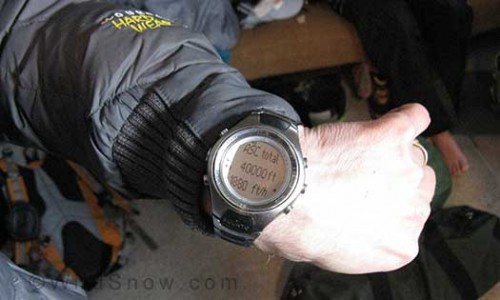
Having hit 40,000′ of climbing and skiing at the 24 Hours of Sunlight, I’d like to say I can now rest easy, except I’m still in too much pain.  Someday, hopefully soon, I’ll rest easy, but the best I can do until then is just to be very psyched.

The first year I did the race I had absolutely no idea how much vertical I could do as my biggest day of touring before that had been about 12,000′.  So, 20k?  30?  I ended up hitting about 36,000′ that year and right at the end realized if I had been more consistent, I might have hit 40.

40k and not an inch more. I can skin no more forever. Photo by Lou Dawson - WildSnow.com

Having a goal for a race like this is incredibly useful as it helps with pacing.  Forty thousand feet means a lap average of 53 minutes, or climbing at an average of about 1,850′ per hour.  This isn’t bad at first, but at least in my case, I had to assume that I was going to slow down towards the end, so the first laps would have to be a bit faster, the middle would have to be right on average, then the end could get a little slower.  The subtleties of this is that if you start out too fast, you’ll burn out faster as well.

My main interest in hitting 40k was that;
    a) it is a nice round number,
    b) I came close to it last time
    c) One of the first times I met Greg HIll he had recently done a 40k and I thought,and still think, it was a very cool goal
    d) There is/was no way in hell I will ever hit 50k.

The good hearted announcer kept referring to me as a "cagey veteran" although at this point it was more like "the crippled veteran."  Photo by Courtney Phillips.

The good hearted announcer kept referring to me as a "cagey veteran" although "crippled veteran" was closer to it at this point. Photo by Courtney Phillips.

While the race itself was fun and all (??!?), one of the great things about busting out a new personal high is that now a “big” day of touring, like 15,000′, no longer seems so daunting, especially as you now know what to expect.  It’s a bit like rock climbing exposure in that after you have climbed something like the 3,000′ El Cap in Yosemite, little 1,200′ walls in Zion seem like child’s play.

As a soloist, the race itself is pure drudgery.  Contestants go up one groomer, then down another, then repeat until they explode.  At one point my stomach was so hammered that I ended up doing a progressive four-part hurl on the course, which alarmed the racer nearby me much more than myself.  “Hey #1 – are you alright?  Do you need help?”  I actually felt much better and kept going.

Comparative lap charts from the two years I've done the race. The one on the top is the first year, which was erratic. The one below was from this year which was more consistent (my goal).

In the Misery Loves Company department, it was interesting to hear Eric Sullivan (the race winner and course record setter with 51,000′+ a year ago) say that he had withdrawn for a few laps as his stomach was punched out as well.  He said something to the effect of “You need to consume a lot of high energy food and drink, but it is hard to digest a stomach full of it in a single lap.” Keeping solid food down is definitely my biggest challenge during 24 hour races and it would probably be well worth it to stop in the future and just force something down.

From a techie standpoint, there are quite a few little tricks of the suffering trade if you are interested in giving it a try.  An attentive pit-crew is essential, and in this case we were lucky to have Courtney Phillips from Salt Lake City and Lou and Lisa Dawson from Carbondale helping us (Polly, Andrew and Rick) out.  Having two pairs of skis and multiple pairs of skins helps so that you can step out of one and go directly into another.  An outside tent vastly increases the creature comfort of the pit crew, especially if you can set it up with heaters and a stove.  It gets fairly cold at night, so drinking warm (but not hot) fluids is a luxury.

Polly, Courtney and Lou looking at the real-time results in our tent.

Perhaps the biggest advantage of hitting 40,000′ is now I don’t feel compelled to do the race ever again.  :)  But, it is a great adventure in human endurance & spirit, so I hope to be back next year either as part of a team or better yet, to help someone else hit their goal (Courtney… Griber…).

________________________________
Help support StraightChuter.com and get credit for every inch you climb with a Suunto X6HRM Stainless Steel Altimeter Watch from Backcountry.com. Click on the photo below…