Monthly Archive for June, 2008

Page 2 of 2

Ski Mountaineering in Iceland – Photos

In May of 2006, I joined Matt Turley, Dylan Freed, John Griber, John Armstrong and Rob Raker on a trip to northern Iceland for some ski mountaineering.  Matt Turley was the originator of this trip as he had been to Iceland in the summer to shoot photos and thought it might make for some good skiing in the winter.  He was right.  At the same time, the Producers of the movie “Steep” were looking for some backcountry footage and sent along a film crew (Griber, Armstrong and Raker). 

The weather was brutally maritime with mostly manky, cloudy, overcast, windy/snow conditions followed by brief spells of clearing.  Overall it was an excellent trip and highly recommended… just don’t forget to bring your wallet and credit cards as it is one of the most expensive places I’ve ever visited.

_________________
Iceland proven gear from Backcountry.com at 15% off:

Ready for sitting around in the rain in Iceland?  The MHW Beryllium jacket is.

 Iceland has almost every kind of fuel, except white gas.  Luckily the MSR Whisperlite International will burn unleaded gas.

Death by 1,000 Ounces

It is easier to ruin a trip by having too much gear rather than too little.  The issue with too much gear is weight, and too much weight means reduced mobility.  As Ray Jardine, the master of ultralight backpacking says “If you need something and you don’t have it, then you don’t need it.”  This may be pretzel logic, but it is the thought that counts.  At best, cold-weather ski mountaineering is a heavy prospect, so don’t make it worse than it already is.

How much is too much?  It depends, but if you are packing for a trip find yourself thinking “Oh, this doesn’t weigh too much… I’ll just bring it.” you can probably do without it.

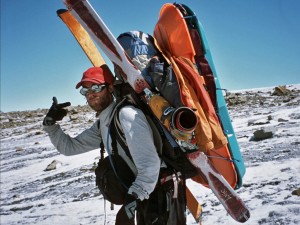
 Ben Ditto preparing for pain in Patagonia.
Ben Ditto (140 lbs) with a 100 lb pack on the Southern Patagonia Ice Cap.  Pure misery.

_______________________________________________________

Lightweight gear from Backcountry.com at 15% off:

The ultimate stuff sack – light, durable and it works.


At .5 ounces, this titanium spork will make you very, very sexy…

The Simple & Sexy Munter Hitch

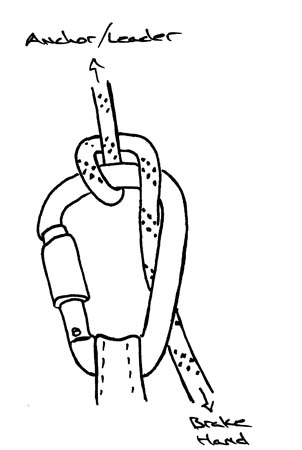
The Munter hitch is perfectly suited for ski mountaineering as it is simple, only requires a locking carabiner, can be fed quickly (for belayed skiing) and is reversible for belaying or rappelling.  Also, unlike many belay devices, it works well with smaller diameter ropes.  The downside of it is that it requires constant brake-hand pressure, so if you let go, you can easily drop yourself or the person you are belaying.  It also kinks ropes, but for the occasional ski mountaineering belay/rappel, that’s a small price to pay.

The glorious little Munter hitch

Continue reading ‘The Simple & Sexy Munter Hitch’

High Stakes Tent Anchors

Getting your tent shredded by wind or snow is an educational experience you only need to do once to appreciate how bad it is.  They don’t just kind of explode, but go in a chain reaction of snapping poles and ripping fabric which leaves you wrapped in a cocoon of nylon and sharp aluminum pole ends.  Fun!

Most good quality tents can take very high winds if they are secured properly, which can be problematic in soft snow.  A good trick is to use those worthless looking little stakes which often come with tents, but instead of driving them in like nails, bury them as mini deadman anchors and attach them to the tent with a length of accessory cord.

Ingredients:

6-10 eight-inch aluminum tent stakes
6-10 forty-eight inch lengths of 3mm accessory cord.

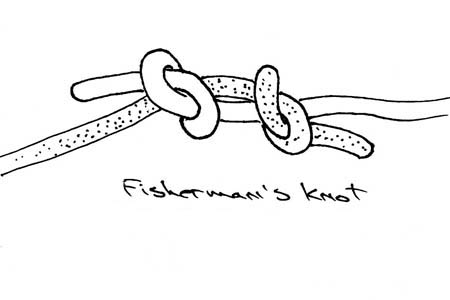
Tie the cord into loops with a Fisherman’s knot.


Girth hitch the accessory cord loops to the tent loops.  I usually leave them on the tent.

 Girth Hitch to tent end.

Girth hitch the other end of the accessory cord to the tent stake.


 Girth hitch the stake...

The finished anchor looks like this:

 The assembled tent anchor.

Set the tent up, pull the anchor taut, note where the stake is in the snow, dig a hole with your shovel at that point, then cut a slot for the accessory cord, place the stake down in the hole, bury it, then stomp the snow down around it.  After a few hours, the snow should set up and the anchors will become bomber.

 The finished work of art...

As an added bonus, these anchors are fairly easy to dig out afterwards and the accessory cord can take direct hits from a shovel.  If it gets cut, just tie it back together. The aluminum stakes are also good if you happen to be on firm, dry ground where you can pound them in.

 Here’s a little video of a tent withstanding a 45-knot storm using this type of anchor. 


________________________________
Help support StraightChuter.com and get a ten-pack of burly North Face Tent Stakes from Backcountry.com. Click on the photo below…
 

Rap Master

If you suspect that a ski descent might require a rappel, it is a good idea to bring a small assortment of gear in case you have to set an anchor.  Trees and rock outcroppings are the best anchors if you can find them, but often times it’s necessary to whack in a piton, Stopper or cam to create a secure point to rappel from.  The amount of gear you need for setting anchors varies, but 10 or so pieces ranging from knifeblade pitons to fist sized cams will get you through, over and around almost any obstacle.

The best gear to use for anchors is your oldest and least valuable, as it will become one with the mountain.  Bring along an ice ax with a hammer on it to apply a little extra lovin’ to those tight fitting pieces and remember, your life is worth far more than a few old nuts and cams.  When it doubt, back up your rap anchor with extra pieces.

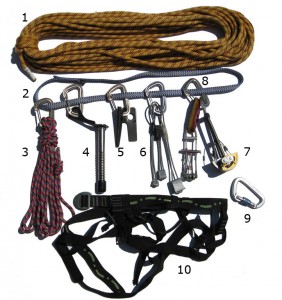
Here’s a sample rap kit:

Rap gear

1.   8mm x 30m (or thicker/longer) rope
2.   Full-length runner. Good for looping over rocks
3.   25′ of 6mm accessory cord. Can be chopped up, or used to extend anchor points.
4.   22cm ice screw. A good anchor itself, or useful for making V-Threads
5.   Pitons – these go in when nothing else will and create excellent anchors
6.   Stoppers and/or nuts. The best bang for your rappelling dollar.
7.   Cams – at times, these work when nothing else will.
8.   Carabiners – used to connect anchor points, or as the main rappel point (doubled-up)
9.   Locking ‘biner – needed for a Munter Hitch rappel
10. Harness – the simpler, the better.

Keep the rock gear organized on the full-length runner and packed in a small stuff sack so that it doesn’t shred everything inside your pack and is ready to go.  If you think you are going to rap, put your harness on before dropping in so you don’t have to do it while you’re sketched out on top of a big drop.

 Packed Rap kit

 ___________________________________
Rap Gear from Backcountry.com at 15% off:

Beal 30m Rando Rope – compact and perfect for ski mountaineering.

Petzl Attache Locking Carabiner – smooth, strong and small.

Petzl locking Biner 

2008 Hans Saari Memorial Fund Ski Mountaineering Camp

The second annual Hans Saari Memorial Fund Ski Mountaineering Camp took place June 9-13 in Jackson Hole, Wyoming.  The camp is a unique program put together by the Hans Fund to teach kids how to go ski mountaineering.  Organized through Exum guides, the camp features two days of background training, then a trip into the Grand Teton National Park for three days of skiing, camping and climbing in the shadow of The Grand.  This year ten students were picked from 25 applicants and about half of those picked were awarded full scholarships to cover the tuition costs.  Not a bad deal!
The first two days of the backcountry portion of the camp had heavy snow – a surprise for everyone, since it was June 11th.
img_0335.jpg
The purpose of the camp is to teach kids ski mountaineering basics.  The first part of the course was taught by Bean Bowers and Nat Patridge, with Hans Johnstone and myself joining in for the second half.  Nat, Bean and Hans have vast amounts of experience in the Tetons and were able to direct us to the Sliver Couloir on the second day…
img_0394.jpg
… and then the Hourglass Couloir on Nez Perce on the last day.
  img_0518.jpg
This was my first time being involved with the camp and I was impressed with how much fun it was for all involved, and also how legit it was.  The kids carried their own packs, booted up steep chutes and cranked turns down some classic Teton lines. It was an excellent introduction to ski mountaineering and will make all of the kids future trips seem easy!
  img_0638.jpg
Photo Gallery

One for the Road

One of my favorite pieces of travel advice came from a hokey little magazine article about family road trips, but the advice is applicable to ski mountaineering trips or expeditions as well. The basic idea is to force yourself (and your partners) to spend one minute of contemplation before you take off going through a list of things you need to bring. Skisbootspoleshatglovesgogglesmoneydrugsfood?

Prepping for a trip always takes longer than expected and often ends with a last second dash for the car, squealing wheels and a mad rush out the door. It is only when you are twenty minutes down the road that you remember that your wallet/boots/jacket are right where you left them… safely back at the house.

Now you have to turn around, go all the way back, then back again, which makes you REALLY late.

The trick is to nip the panicked exit before it begins, which is right as the car key is heading for the ignition. Put the key down, look at the clock and force yourself to think for a full minute before you begin. The minute you spend could save you hours afterwards.

_________________________
Click the bag for 15% off from Backcountry.com on a burly MHW duffle.

The Last Word on First Aid

First Aid and CPR classes are like classic literature—everyone agrees they are great, wonderful and important, yet few people have actually made it all they way through them.  Skiers are optimists and the chances of ever actually having to perform CPR or First Aid are remote, which makes it easy to blow the classes off.  However, the real importance of CPR and First Aid classes is not so much in learning the mechanics of chest compressions and how to bandage a severed stump, but more that the classes force you to think about emergency situations in advance, so that when accidents do happen, you can provide aid with increased confidence.  You’ve seen it before, thought about it, been tested on it and even if you forgot most of it, the increased confidence and calm will be invaluable.

Cardiopulmonary resuscitation (CPR) is most often associated with heart attack victims where it is marginally successful.  In terms of ski mountaineering, where CPR really shines is in resuscitating avalanche burial victims and restarting a person’s heart after a lightning strike.  Remember, a person is not dead until he is warm and dead and CPR is perfect for these two situations.  Don’t give up on them.

Mark Holbrook looks at Conrad Anker\'s head injuries.
Mark Holbrook wondering what to do about Conrad Anker’s head injuries after a massive avalanche accident.  In the end, the wounds were cleaned, bandaged and wrapped.  Conrad was able to walk out on his own.  Tibet – 1999

When it comes to First Aid in the mountains, one of the best things to know is that you can’t really do much aside from stop the bleeding, make the patient comfortable and know when/if it is safe to transport them.  Backcountry appendectomies rarely turn out well and are best left to doctors in operating rooms.  The key to backcountry medical emergencies is to not make them worse than they already are.

Backcountry First Aid is a matter of improvising.  With all of your ski gear available for splinting and clothes which can be cut up in an emergency, you have almost everything you need to deal with injuries.  Along with the knowledge of how to use it, a small First Aid kit with bandages, gauze and the absolute bare essentials is all you really need.

 ——————————
15% off on 1st Aid Kits from Backcountry.com:

The Adventure Medical Pocket Medic is all I usually carry for a day of backcountry skiing.

Adventure Medical Pocket Medic 

For expeditions, I carry something like the Adventure Medical Traveler First Aid Kit.

 Adventure Medical Traveler First Aid Kit