Monthly Archive for June, 2008
Ski Mountaineering Partners – Intro

Superficially, ski mountaineering is an individual sport. You do not need a partner to make turns, enjoy deep powder and appreciate a mountain setting; yet having one transforms the experience into something even greater. Partnerships are at the core of the sport, and without them ski mountaineering would barely exist.

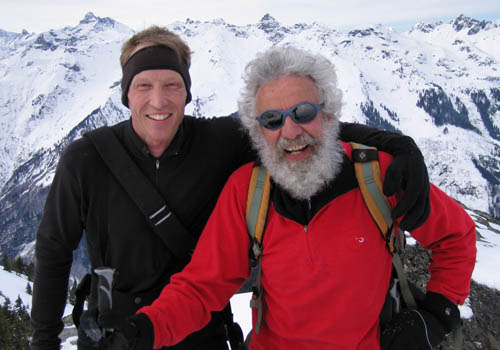
Reto & Hombi from Switzerland
Reto & Hombi from Switzerland.  These guys have been making turns together for years!

Behind any great ski mountaineer, there is a great partnership. Partners motivate each other, provide complementary skills, make breaking trail easier and increase each other’s safety in the mountains. Almost all of the greatest adventures and mountaineering feats in history have either involved, or were the result of strong partnerships. Where you go with your ski mountaineering is closely linked to the partnerships you create along the way.

Finding good partners takes time, effort and persistence. It does not always happen easily, but the rewards last a lifetime. More than money or skill, a strong partnership is your ticket to the most exotic locations on earth. Where there is a partnership with a will, there is an adventure waiting to happen.  Oftentimes you may not even appreciate what a great skiing partner you’ve found until they are no longer around!

Seasoned partners are prized friends and interesting people. After years of skiing together and hundreds of shared experiences, they develop an understanding that borders on mind reading and reduces communications to the bare essentials. Comments like “why don’t you take it and hook under the rock” make perfect sense to a like-minded partner, but could take hours to explain to others. This type of understanding between partners is essential when the going gets tough.

The key to finding good partners is first to be a good one yourself. Partners have an unquestionable responsibility to each other and, consciously or not, people seek out others that they can trust. This sense of trust is the root element of enduring mountaineering friendships and the ideal starting point for new ones.

Tomorrow – What Makes a Good Partner.

________________________
15% off Motorola SX600R radios for keeping track of your partners, at Backcountry.com

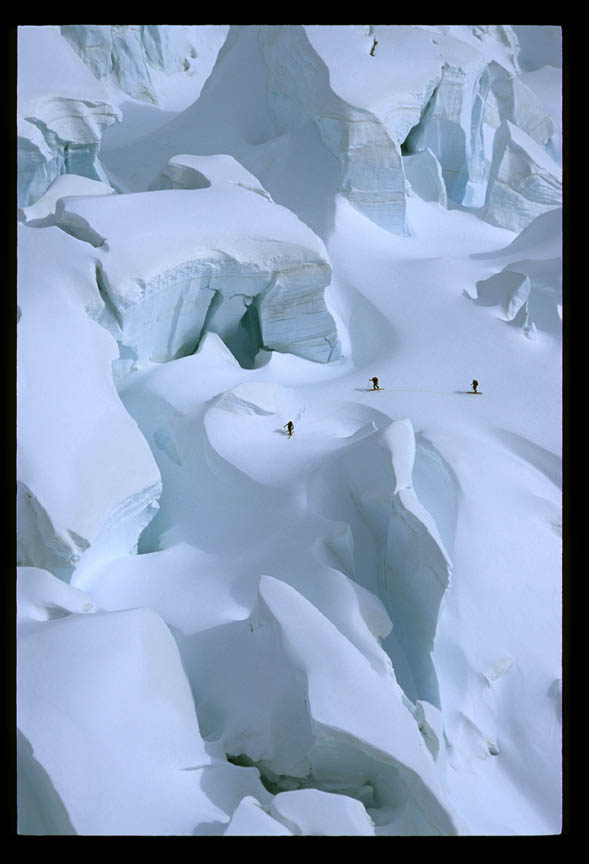
Sunday Photo – Tasman Glacier Icefall, New Zealand

This classic photo by Chris Figenshau has a funny background to it.

Wandering through the icefall

Steve Romeo, Chris Figenshau and I flew down to New Zealand to do some skiing in the Mt. Cook National Park with Kiwi local, Grant Guise.  We were flown into the Tasman Saddle hut and as we were shuttling our gear to the hut, a bag of pasta slipped out and shot down a blind couloir.  It wasn’t life-threatening, but later Grant and I skied down below the hut to look for it and found the couloir got steeper and steeper, then ended in a giant open maw of a crevasse!  The pasta was one with the glacier.

On the way back up to the hut, Grant and I decided to go right through the icefall as it was fairly short and we had ropes and plenty of time.  Chris was able to watch us from the top, and being a photographer, took a bunch of photos, but didn’t quite get what he was looking for, so he asked if all of us might want to do it again, which we did.  This time we had radios, so Chris was able to direct us through an outrageous path up the center of the icefall which we probably never would have found without his bird’s-eye view.  He shot this photo looking down from the hut, which is perched on a rock outcropping and falls away 100’s of feet on three sides.

________________________
15% off an Ibex “Mollie” jacket made with Merino Wool from New Zealand at Backcountry.com

Spare Gear

Skins and beacons are popular items to forget, which shuts down a tour before it even begins.  It’s almost a physical impossiblity for a person booting through deep snow to keep up with a group on skins, and forgetting a beacon not only means you won’t be able to find them, but they also won’t be able to find you!  Because of this, keeping a spare beacon and set of generic skins in your car can rescue many wayward days of skiing.  A bonus of retiring your old beacon to a dedicated car beacon is that you will already know its history and how to use it.

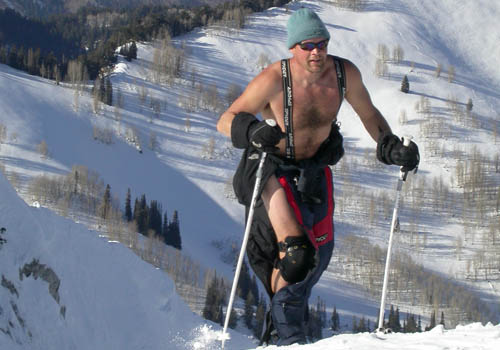
Forgetting gear is a lot like skiing naked...
Forgetting gear is a lot like skiing naked…

Shovels and water are also common show stoppers.  A spare shovel in the car is a good idea for digging the rig out of a snowbank and a liter of water has many uses as well… assuming it doesn’t freeze.

 ________________________
If you are like George and only bring kneepads, at least get a 15% discount on them from Backcountry.com

Field Repairs

Field tuning ski gear is less than ideal, but often times necessary if you go on an extended trip with endless icy or gloppy conditions.  As with most expedition situations, inspiration is more important than perfection and the goal is to make due with what you have rather than packing extra gear.

Edges Sharpening
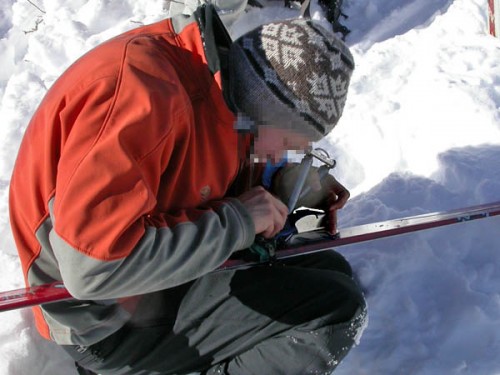
It is hard to believe until you try it, but those tiny little files on high-quality Multi-Tools do a passable job sharpening edges.

Wax Job
Skin wax also works as base wax if you rub it in.  Better yet, bring a block of regular warm weather wax and use that as skin wax.  It’s cheaper, multipurpose and works as well as “official” skin wax, which can be marginal depending on conditions.

Blown Binding Screws
Spare binding screws are the tiny cornerstone of a minimalist repair kit as they don’t weigh much and are virtually impossible to replicate in the field.  Loose screws can be tightened up by lining the stripped hole with tin foil, energy bar wrappers, chunks of a Space Blanket or any sort of tough, flexible film.  Steel wool works better yet if you happen to have it. The important part is to gently put the screw back in, as they are easily stripped.

 Blown bindings are a bummer.
For such little parts, binding screws can have a huge impact on your day.

Tail Delams
Tail delaminations are the beginning of the end for a ski and even delams fixed in a shop are dubious.  In the field, the best you can do is to slow the delamination process by crudely screwing it back together, or stitching it with wire.  Tail delaminations are best avoided from the start by not throwing your skis off of cliffs you are downclimbing, hucking them across rivers or ramming them too hard into the snow for anchors.

JB Weld
There is almost nothing in the ski world which can’t be fixed with JB Weld.  It acts as a burly epoxy and can also be lumped on, then filed into shape for recreating broken plastic parts.  It requires a clean, dry surface and roughly 24 hours of warm temperatures to cure, which makes it impractical for day tours, but it is ideal for any trip over a three days.

________________________
15% off a Leatherman XE6 Multi-Tool (with file, pliers and scissors) from Backcountry.com


The Ten Minute Tune – Technique

Once the vise, bench and basic tools are acquired, it is time to hit the stopwatch and start a ten-minute tune.  It is better to do the tunes as a matter of routine before you put the skis away so you don’t blow it off in the excitement of the moment when you are ready to go.

First off, wipe down the bases with base cleaner/lacquer thinner.  Try not to flood them as it just takes longer to dry.  The basic idea is to get skin glue and other gunk off.

Now, always working from tip to tail, run the metal scraper along the bases to further remove embedded gunk and knock off any high points.

 Scrape off the high points.

Next up, flat file the bases with that killer new file you just got…

Base filing - this is often the hardest and most time consuming part of the ten minute tune.


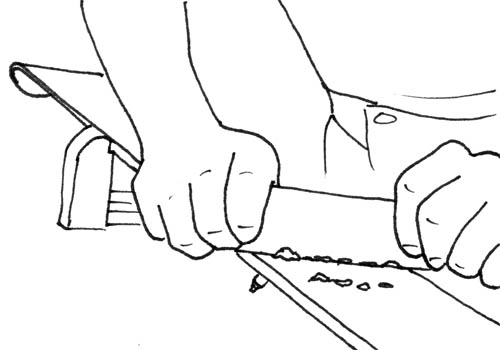
 Flip the ski up and holding the file as perpendicular to the bases as you can, give each edge a once-over.

 File those edges, but becareful not to over do it.

If you are in the mood, smooth the edges down with the Diamond Stone.

Voila!  Your bases are now sharp, but don’t glide very well, so it is time to wax them.  Starting with the “cotton” setting, adjust the temperature to just below where the wax starts to smoke.  Smoking wax means you are damaging its slippery little molecules.  Like the base cleaner, try to put on just as much wax as you need, otherwise it just takes longer to scrape it off and clean up.

 Wax\'em up.

 So close!  The clock is at eight minutes and thirty seconds, so it’s time to scrape the excess wax off your bases with the plastic scraper.  These get dull after a while and can be sharpened up by running them through a table saw and taking a tidbit off.

Scrape\'m Danno!

If you want to hide any scratches and improve your initial glide a bit, go over the bases with the Scotch-Brite pad until they have a uniform matte finish.  Minor scratches can be filled with wax, then once you get a collection of them, or some big diggers, you can P-Tex them all at the same time.  Huge core-shots should be trimmed out, cleaned up, and filled with epoxy, or taken to a shop for professional care.

Stop the clock!  Slap your skis together, put the skins on top, lash them all together with a ski strap and hang them up, ready to ride at a moments notice.

Doug Coombs was a fan of the “Quick & Painless” speed tune, and described it as “Maybe it’s the most screwed up tune in the world, but I’m use to it, so, it works.”

The Quick & Painless Tune video as described by Doug Coombs.

________________________
Bulk wax doesn’t do it for you? Get 15% off Toko Dibloc LF wax from Backcountry.com

The 10 Minute Tune – Tools

Tuning backcountry skis is important, but doing a good job at it is not.  Backcountry skis take such daily abuse that you could easily spend more time tuning them than skiing on them if you insist on a perfect World Cup racing tune.  It is a matter of quantity, not quality, and the secret to quantity is to make it fast and easy.  Giving your skis a ten-minute quick tune every few times you take them out makes them a lot more fun and precise to ski on.

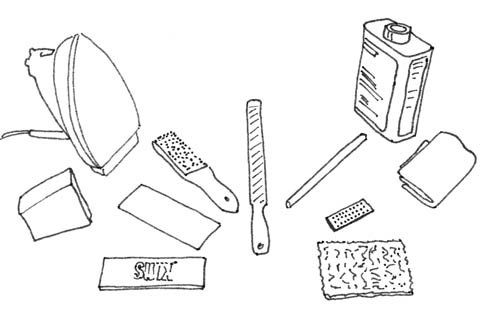
Stripped down tune-up only requires the most basic tuning tools.  The goal is to clean the bases, sharpen the edges, put some wax on them and give the bindings a visual safety inspection.

 A basic backcountry skiing tune-up kit.

Tools of the Quick-Tune Trade:

Rag
Base cleaner (lacquer thinner works)
Metal scraper
Plastic scraper
10″ file (worth getting a good one)
File card/brush
Medium Diamond Stone (coarse)
Wax (warm weather bulk wax)
Iron
Scotch-Brite pad
P-Tex repair sticks

For bulk wax, find a generic all purpose version as you never know what kind of conditions you’ll find in the backcountry.  On the file, even if the $20 version looks the same as the $8 one, the difference is in how hard they are.  Ski edges are heat-treated to a high Rockwell hardness rating which will ruin a cheap-o file in a tune or two. Even though it looks like you are getting a lot of metal filings with a cheap file, they are actually coming from the file, not the edges.

________________________
15% off a Swix starter kit from Backcountry.com

Vise Squad

Tuning (or trying to tune) a pair of skis without a bench and a vise is almost worse than not tuning them at all.  The skis fall over, you slice your hand, the wall gets scratched and the tune comes out marginal at best.  The backbone of a good tuning system is a solid bench and the heart of the system is a good ski vise. 

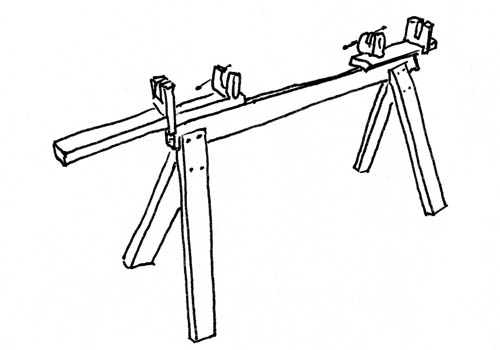
 A good place to start for a bench is a sawhorse.  These are nice as you can walk 360 degrees around them, and by trimming the legs down, you can operate on your skis at waist level, and thus apply more file/scraper pressure.  The basic set-up shown below is a wooden sawhorse with secondary chunks of 2 x 4″ pieces of wood screwed on top, then the vises mounted to that.  A bonus of the sawhorse bench is that it is also easy to clean up afterwards and it can be stored out of the way.

A good ski vise can be the most expensive part of a tuning kit, but they are essential, especially with rounded, shapey cap skis which are tricky to hold. 


Use blocks to help support the tips and tails.  If you have the technology (a saw), cut slots in the support blocks so you can plug your skis in sideways and work on the edges without having to clamp/unclamp them.  Close enough is good enough.

________________________
15% off ski tuning supplies from Backcountry.com

Toko DMT Diamond stones are a nice way to tell your skis “I love you.”

Preventative Maintenance

Most backcountry ski equipment will live a long, happy life if treated with care.  When used as intended, it’s possible to get many seasons out of a pair of skis, boots or bindings.  When not used correctly, it can break on the first day, which explains why Boy Scouts and Girl Scouts are well known at Warranty Centers.  A ski may look like a pry bar or have sharp edges like an axe, but should not be used to move boulders or split wood.


The life of a backcountry ski would make a World Cup ski tuner cry…

Preventative maintenance is an excellent way to extend your gear’s life.  A good habit to get into is to wipe your bases down and prop your skis upside down to drip-dry when you are done for the day.  This helps keep the edges from rusting and your bindings from getting gummed up with sludge.  Skins should be hung up to dry as well. Boot liners will dry much faster if pulled out of the shells. 


Another important part of preventative maintenance is having a good storage system.  Nothing kills off a fresh edge sharpening quite like having your skis slide off the wall, scissor the edges and land on some open paint cans.  Two dowels drilled through a ceiling joist make a quick, cheap and effective place to hang your loyal ski-steeds.

 ________________________
15% off from Backcountry.com

Sunday Photo – Baffin Island Iceberg Camp

Editors Note: Sundays are meant for skiing, climbing, riding and almost anything but sitting in front of a computer.  Still, the Internet never sleeps and Sunday’s are a good time for ski mountaineering photos and the story behind them.

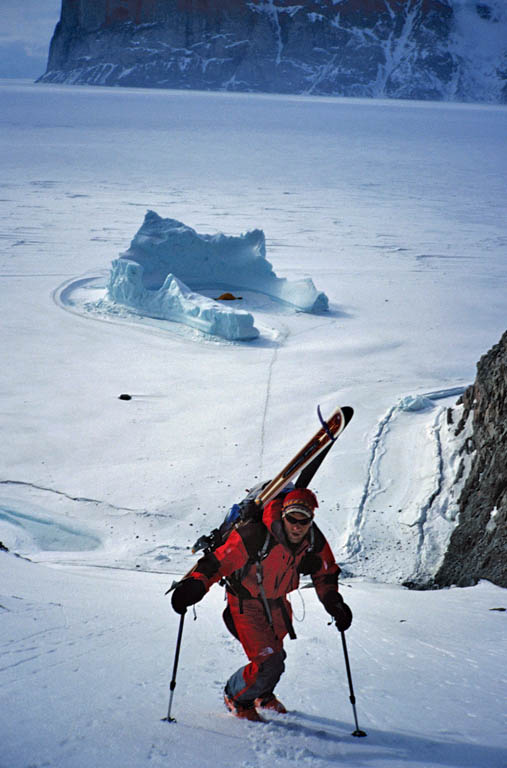
Baffin Island Iceberg Camp – 2002

Brad Barlage booting up the Model T couloir. Baffin Island

While watching a Mike Libecki slideshow on Big Wall climbing in Baffin Island, I kept catching glimpses of tasty looking couloirs in the background of scenic photos and wondered if they were skiable.  As it turned out, most of the descents off of the huge vertical walls were by walking/sliding down nearby couloirs.  When I asked another skier/climber who had been to Baffin how many of these couloirs there were in the area, he said “Oh God! Hundreds!”  That was all the info needed to start planning a trip to the area.

In 2002, Brad Barlage and I spent four weeks in the Sam Ford Fjord area of Baffin Island doing some of the best skiing of our lives.  In this photo, we had moved camp to an area with 3-4 chutes in it and found a melted out iceberg which had drifted over from Greenland.  It’s good to camp near icebergs as they are a source of clean water for melting, but in this case, we were worried about an avalanche coming down the couloir and nailing the berg like a perfect catcher’s mitt, burying us in the process.

In the end, it was just too cool a campsite to pass up and the snow was stable enough that we spent two nights camped there.  At one point, some of the berg itself calved off and almost hit Brad, but aside from that, it was excellent.

 ________________________
15% off aluminum crampons perfect for booting up Baffin couloirs from Backcountry.com


Love Thy Bases & Bindings

Skis and bindings have a hard enough life without getting sandblasted by road salt, grit, acid rain and polluted snow while riding naked in a roof-top car rack.  Ski bases can be cleaned off, but road grime is especially damaging to bindings, and much harder to clean.  Transporting your skis inside the vehicle is the best way to keep them clean and lovely, as well as upping your gas mileage.  If they must ride shotgun on top, at least put them in a ski bag.

 Not feelin\' the love here...
Naked and exposed on top of a car – how NOT to love your skis, bindings and skins!
 
________________________
15% off ski bags from Backcountry.com