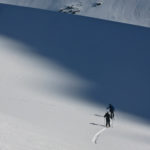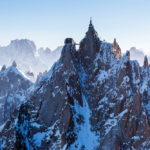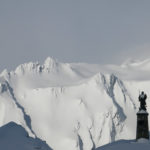
Scotties is a classic little Wasatch one-hitter. It is in danger of being over-run by Snowbird as it borders the resort, but if you time it right, it can serve up a nice powder run.

Looking up at the lower 2/3rds of Scotties from the White Pine trailhead.

Scotties, from the top, with feeling.

Scotties mid section... with even more feeling. Nice view.
________________________________
Help support StraightChuter.com and get an Avalung infused Black Diamond Covert with Avalung Winter Pack from Backcountry.com. Click on the photo below…

Trying to clamp down the latest generation of wide skis for a tune-up is like wrestling an eel in a vat of Crisco. Forget it. Because they are so wide, yet have a thin cross section and rounded topsheets, traditional tuning clamps will hold skis only long enough to look secure, yet the first time you lay into your bases with a file, the ski pops loose and you drive the back of your knuckles directly into the steel edges, slicing your hand open and gushing blood. It’s enough to make you not want to tune your phatties.
To help hold skis in place, a few companies (like Swix) make rubber devices that wrap around your bindings and pull the ski to your bench. Click here for details on my bench setup. I was tempted to buy one of these, but thought I’d try a piece of accessory cord and a hardware store cleat first. Much to my wallet’s relief, it works really well and the total cost was $1.19.
Start with a piece of accessory cord about 24″ long. Tie a small knot in one end and use that to make a loop, which is then wrapped around the binding (this works with almost any style of binding).

From here, push the ski down, then wrap the cord around the cleat, as shown in the photo below.

The flex of the ski gives you a little extra holding power, and although the ski isn’t absolutely locked in place, it is close enough to allow you to reef on it for some heavy-metal base filing. As I already had them, I still use the vises, but more for alignment than clamping power.
________________________________
Help support StraightChuter.com and get a starting grip on your slippery eels with a Toko Ski Vise World Cup from Backcountry.com. Click on the photo below…

One of the cruelest avalanche tricks out there is the old “I was just minding my own business skinning up a nice valley when suddenly both sides collapsed thousands of feet above me and I was buried 20′ deep.” It is a mean spirited trick as the skier may be on flat ground far away from the starting zone, and to add insult to injury, it is often fatal. This particular type of avalanche is different from the “wrong place, wrong time” slide where a skier happens to be below a slope when it decides to cut loose, because in this case, the skier is actually triggering the slide remotely from hundreds/thousands of feet away.
From studying Architecture, this phenomena reminds of an architectural arch, where all of the compression forces are balanced and held in place by a keystone at the top. Exhibit A below:

A collapsing valley is basically the same thing, except the arch it turned upside down, and instead of carved stones, you have a cohesive slab of snow. When an unsuspecting skier walks along the base of the valley, he is essentially knocking out the keystone that holds the valley walls up, as illustrated below:

This type of avalanche is very difficult to accurately predict, but not that hard to avoid. If the snowpack has pronounced collapsing (like the Wasatch has had this season), it means that keystone is being punched out and it would be better to stick to the high ground. The chances of getting caught in a slide like this are about a million to one (unless you live in Colorado, where it is more like 50/50) and the best defense is to be forewarned.
________________________________
Help support StraightChuter.com and pinpoint a deep burial quickly with a Pieps iPROBE Probe from Backcountry.com. Click on the photo below…

At a recent seminar, a speaker from “Backpacker Magazine” described his reader base as “geo reference oriented” which I think was a nice way of saying “geeks with GPS’s.” As I am guilty of the same sin, I wanted to see about putting some classic Wasatch tours on-line and see how it works.
The tour below (Pink Pine, an excellent quick outing, or safe first tour) is created in Trimble Outdoors and has all sorts of download options, including sending it to your GPS enabled phone. Since I don’t have one, I’d be interested in seeing how it works if anyone actually tries this. Continue reading ‘Pink Pine Ski Tour – Topo & Guide’
I recently attended a seminar at the Winter OR Show entitled “Print is Dead” which had a panel of outdoor writers and e-commerce people, including Steve Casimiro. Steve has been one of my favorite skiing writers since his days at Powder, and the upshot of the seminar was that print isn’t really dying so much as becoming one of many other means of publishing. People kept referring to Steve’s website, The Adventure Life, so I checked it out and discovered (among other things) that Scott Markewitz was giving a photo workshop at Snowbird.
I’ve known Scott since I moved back to Utah about 18 years ago, and knew of him before that through his photography. As far as I know, Scott was the guy who invented the genre of skiing photography where you see a tight frame of a skier completely engulfed in a sea of raging powder, with perfectly lit up details and the person is calming looking through his/her goggles directly into the camera. Photos like these are the embodiment of speed, action, details, nature and humanity all rolled into one, which is probably why Scott has had several hundred magazine cover shots. And skiing is just one of many things that he shoots. There’s a photo on his website of girls throwing snowballs at each other, that makes it look like such fun that I want to give it a try.
My personal photography style is best described as “Point & Chute” where I carry a small Point & Shoot camera set to full auto with the burst mode on, pull it out when things look interesting, fire off a bunch of shots and hope for the best. This usually yields about a 1 in 1,000 ratio of good to crap, and from working with professional photographers, there’s no doubt that carefully setting up the shot is 90% of the game. In that regard, I’m very psyched that Scott is teaching a clinic and willing to share some of his techniques.
The clinic is Feb 4-7 at Snowbird and for $1,250 includes food, lodging, ski tickets and the workshop, although there is also a locals deal available if you just want the workshop. Contact Scott at scott@scottmarkewitz.com or book through Snowbird at 1.800.453.3000. It should be fun.
Trivia:
Inclinometers are used in aircraft to show magnetic dip or the angle from the horizon.
Clinometers are used by surveyors in order to measure an angle of inclination or elevation.
Goniometers are instruments that either measures angle or allows an object to be rotated to a precise angular position.
Regardless of what you use or what you call it, being able to measure slope angles is one of the best avalanche defenses available. I’ve been skiing around for the last week in considerable, high and even extreme avalanche conditions without seeing or triggering any slides as I’ve been keeping my angles loooooow. Like in the 20-30 degree range at the most.
For years my goniometer (I usually call it an inclinometer) of choice has been the classic Life-Link plastic card with a dingle-bob on it. After a few seasons, the plastic breaks and you are left with a shard of plastic and a stuck dingle-bob. Still, they were kind of cheap, lightweight and compact enough that you could whip it out, pull an angle and get on with life. With this in mind, I was overjoyed at the recent Outdoor Retail Show to see that Pieps had come out with a bitchin’ new digital unit that mounts to your pole and also includes a thermometer. Continue reading ‘Pulling Slope Angles’
I love the idea of regluing skins, not just because it is all eco earth friendly and vegan approved, but because a pair of moderately worn nylon skins have such a nice feel to them – they glide, climb and fold-up like butter. With this in mind, I stripped the old glue off of a pair of skins last year and carefully documented my first outing with Black Diamond Glue Renew strips in eager anticipation of a KILLER BLOG POSTING. Yeah, well, it turned out like crap as I have the patience of a two year old and once again forgot to read the instructions until after I finished the job. Continue reading ‘Glue Renew Guru’
It’s about time the Wasatch got some snow, dammit. It was a mixed blessing to open my garage door this morning and find that the overnight snowfall was thigh deep and over the top of my snow-thrower hood, which necessitated a double pass, which in turn made me late, which led to getting stuck in the Cottonwood Canyons traffuck, and once we finally got to the trailhead almost an hour later, I pulled my beacon out to find that it had been left on and was reading “00″ as a power level (details below). It wasn’t a great start to the day, but it soon improved, as photo Exhibit A shows below: Continue reading ‘Deep Snow and Shallow Batteries’
The Outdoor Retailer Show is in Salt Lake City and the Sundance Film Festival is getting underway in Park City, so Utah is hopping at the moment. A bit more snow would make it even better.
I’ll add some updates from the OR Show over the next day or so.
Alright, this didn’t work so well last time as I didn’t RTFM (Read The Fuggin Manual), Continue reading ‘Utah Interconnect – SPOT Tracking’